

Sharon Keevins • December 2, 2025

The Ever-Increasing Standing Charge

The ever-increasing standing charge

By Adam Novakovic

While finding ways to decrease consumption can help lower your electricity and gas bills, many of the savings accrued through reduced consumption can be seemingly wiped out by constantly increasing standing charges -- charges that end-users have no control over. As standing charges continue to rise, we take a look at the reasons behind this and whether this trend is set to continue.


What are standing charges?

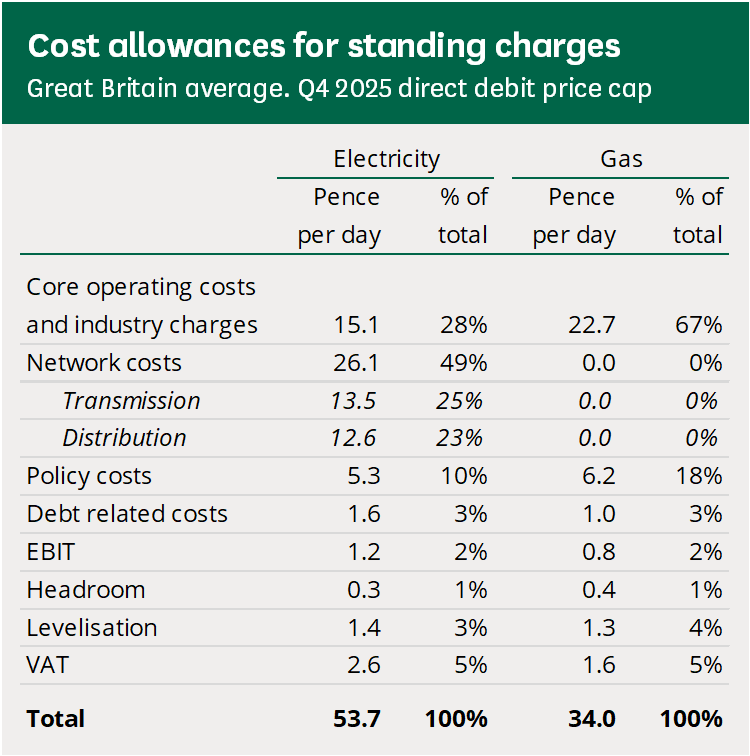
A standing charge is the fixed daily fee you pay for your utilities before you’ve used a single unit of gas or electricity. The intention behind the standing charge is that it covers aspects of the energy network that require funds regardless of usage levels, such as:


  • National Grid and local network costs
  • Supplier operating costs and smart metering
  • Some industry and government policy schemes


A recent government consultation found that around half of the typical electricity standing charge is made up of network costs alone, with a further quarter linked to operating and industry costs.

Suppliers do have some flexibility over where they can recover different costs. Analysis by the research foundation Nesta has shown that a significant share of electricity network and policy costs are recovered through the standing charge rather than the unit rate.


Why have they risen so much in recent years?

The shift has been dramatic. Between 2021 and 2023 it was found that the average standing charges had more than doubled and have further increased since then.

The main causes for these rises have been:

Post-crisis cost recovery: Supplier failures, customer debt and the cost of emergency support schemes created significant fixed costs that regulators allowed suppliers to spread through standing charges.

Network upgrades: Keeping ageing networks running is expensive. The existing networks weren’t prepared for the increasing % of energy derived from renewable sources and needed a rapid update. This was partially down to the short-sightedness of government policies forcing more widespread renewable energy usage.

Risk management for suppliers: Recovering more income through a fixed fee gives suppliers a more predictable cashflow than relying solely on units sold -- especially when wholesale prices are volatile.

The result is that low-usage businesses, who were previously able to save more by cutting consumption, now see less benefit because a larger part of the bill remains unmoved.


Are they set to keep rising?

Looking ahead, there are two key factors likely to dictate how standing charges change


On one side, Ofgem has signalled massive new investment in energy networks -- around £24 billion between 2026 and 2031 -- which it estimates could add around £100 a year to typical bills (but far more for large businesses) by 2031 in order to fund grid upgrades. In recent years, these have been exactly the sort of fixed system costs that end up in standing charges.


On the other side, there’s growing political and consumer pressure to reduce these charges. Ofgem has now confirmed that by early 2026, suppliers will have to offer at least one tariff with a lower standing charge, even if that means a higher unit rate. Although, this will be more targeted at domestic users rather than low-consuming businesses.


While it doesn’t seem likely that standing charges will drop in the near future, the pressure from end-users will likely lead to more choice regarding how much of their energy costs are made up of fixed charges. For smaller consumers, there will be a greater benefit in being able to choose a lower standing charge with higher unit rates should these offerings become standard throughout the industry.


If your business would like more information on standing charges or any of the charges that appear on your bill, don’t hesitate to contact SeeMore Energy today. Our experienced advisors can help you with bespoke strategies and advice that is tailored to your needs.

By Sharon Keevins December 4, 2025
October Review By Adam Novakovic In the month of Halloween, October energy price movements were free of jump-scares. Whilst prices moved up slightly at the start of the month, they marginally decreased throughout the remainder of October. Ending the month slightly below the levels seen at the end of September. The expectation this month was that European gas reserves would be the key story impacting energy prices. The European Network for Transmission System Operators for Gas (ENTSOG) released their report on the Winter supply outlook. This confirmed that Europe is well prepared for the coming winter, with 83 % gas reserves recorded as of the 1st of October, and infrastructure resilient enough to meet demand without Russian pipeline gas. Their projections had Europe ending the winter season with over 30% storage even in the most severe scenarios. There is also the expectation that any unforeseen supply disruptions can be mitigated through increased LNG imports -- supporting the EU’s goal of phasing out Russian gas while emphasising continually reducing demand. During the first week of October Russia launched a wave of drone attacks against Ukraine -- the largest since the war began. These strikes have damaged Ukrainian gas production and left storage at 42% of capacity. This has forced Ukraine to look at importing large quantities of LNG from Europe this winter. With the deal that brought Russian gas to Europe now expired, Europe faces added demand pressure. This comes despite Europe significantly reducing Russian gas imports and increasing LNG imports from other nations. With there currently being a large quantity of LNG available for importation, and with EU gas reserves being in a healthy position, it seems as though further conflict may not have a large impact on energy prices. This could change however if Europe were to experience a particularly cold winter.
By Sharon Keevins December 4, 2025
September Review By Adam Novakovic We have reached the time of year where the summer months have started to fade and we begin to think about the colder seasons. This month saw the UK government recognise Palestine as a country, although they still seem unable to recognise the harm their energy policies are causing UK businesses. With further charges set to be added to UK energy bills and rising non-commodity costs, it was a relief that wholesale energy prices remained fairly flat throughout September. A recent report from independent analysts Cornwall Insights revealed that large energy users who aren’t covered by Government schemes could find that they are paying a further £450,000/year in non-commodity costs by 2030. With non-commodity costs such as DUOS and TUOS charges –which are used to fund the infrastructure responsible for the transmission of electricity – now accounting for over 2/3rds of total electricity costs for some businesses, it is of growing concern that these charges are set to continue rising. With the TUOS charges for 26/27 expected to increase significantly , the non-commodity charges are starting to have a negative impact on UK businesses ability to compete against foreign businesses with fewer governmental charges on their energy bills. This growing concern is yet to be addressed but could have a huge impact on many industries in the next year.

Show More