Understanding Your Energy Bill: Use of System Charges

12 May 2023

Use of System Charges Explained: What Are DUoS, TNUoS and BSUoS Charges?

When reviewing a UK business electricity bill, you may notice several unfamiliar network charges. These are known as Use of System charges and are a major component of non-energy costs.

The three main charges are:


Below, we explain what DUoS charges are, what TNUoS charges are, and what BSUoS charges are, why they appear on your bill, and whether they can be managed or reduced.


What Are DUoS Charges?

DUoS charges (Distribution Use of System charges) are applied by your local Distribution Network Operator (DNO). They cover the cost of transporting electricity from the national grid to your business premises using the local distribution network.

DUoS charges usually include two elements:


1. DUoS Standing Charge

This is a fixed daily charge that reflects:


  • The size of your electricity connection
  • The cost of maintaining and operating the local network


It applies regardless of how much electricity you use.


2. DUoS Unit Charges (Red, Amber, Green)

These charges vary depending on the time of day and local network demand:


  • Red – peak demand periods (highest cost)
  • Amber – medium demand periods
  • Green – low demand periods (lowest cost)


On average:

  • Red charges can be 50 times higher than amber
  • Red charges can be up to 450 times higher than green


These time-of-use charges are designed to encourage businesses to shift consumption away from peak periods.


Can DUoS Charges Be Reduced?

While DUoS charges can’t be removed, they can often be managed:


  • Monitor when electricity is used
  • Shift energy-intensive processes to off-peak periods
  • Use half-hourly data to understand demand patterns


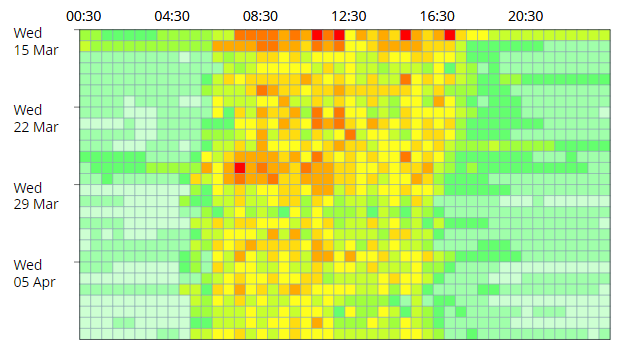
For businesses with half-hourly meters, energy monitoring tools -- such as an electricity footprint report -- can clearly show when and how DUoS charges are being triggered.

 Example of a one-month energy footprint report


What Are TNUoS Charges?

TNUoS charges (Transmission Network Use of System charges) are applied by National Grid. They cover the cost of operating and maintaining the high-voltage transmission network that moves electricity from power stations to local distribution networks.


Key features of TNUoS charges:


  • Charged at a fixed rate per kWh
  • Typically billed annually or seasonally
  • Based on total electricity consumption


Although less visible than DUoS, TNUoS charges can represent a significant cost for larger electricity users.


What Are BSUoS Charges?

BSUoS charges (Balancing Services Use of System charges) recover the costs incurred by National Grid to balance electricity supply and demand in real time.


These charges ensure:


  • System stability
  • Grid security
  • Continuous electricity supply


BSUoS charges are:

  • Calculated based on your share of total electricity demand
  • Highly variable
  • Influenced by renewable generation levels, weather, and system events


Understanding what DUoS charges are, what TNUoS charges are, and what BSUoS charges are gives businesses greater clarity over non-energy costs on their electricity bills.

While these charges are unavoidable, better visibility of usage patterns, contract structure, and consumption timing can help businesses manage and, in some cases, reduce overall costs.


Need Help Understanding Your Electricity Charges?

If you’d like help reviewing your electricity bill, understanding Use of System charges, or receiving advice on securing the best deal when renewing your contract, please contact our team:


📧 admin@seemoreenergy.co.uk


We’re happy to provide clear, independent guidance to help you take control of your business energy costs.

Contact Us for advice on your energy bills

28 January 2026
What are Balancing Services Use of System (BSUoS) charges? Balancing Services Use of System ( BSUoS ) charges recover the cost of keeping the electricity system in balance in real time. Electricity must be generated and consumed at the same moment, and BSUoS funds the actions National Grid Electricity System Operator (NESO) takes to achieve this. These actions include: Instructing generators to increase or decrease output Paying for reserve and response services Managing system constraints and frequency control BSUoS is therefore not about building networks (like TNUoS or DUoS ), but about operating the system safely and securely second-by-second. Who pays BSUoS charges? Since April 2023, BSUoS costs have been recovered entirely from electricity demand rather than split between generators and suppliers. In practice: Suppliers pay BSUoS charges to the system operator These costs are then passed through to all electricity consumers, including business customers Most businesses see BSUoS as a pass-through charge in their supply contracts Domestic customers also contribute, although the charge is typically embedded rather than itemised. How do BSUoS charges work in practice? BSUoS is charged on a per kWh basis, based on actual electricity consumption during each settlement period. The BSUoS rate reflects the real-time cost of balancing the system, which can vary significantly depending on: Weather conditions Generator availability Network constraints Levels of intermittent renewable generation Unlike DUoS or TNUoS, BSUoS is not location-specific. The same rate applies across Great Britain for each settlement period. How much is BSUoS (and when are charges set)? BSUoS charges are not fixed in advance. Instead, they are calculated using a forecast-and-reconciliation model. This means the amount originally charged can be reconciled after the fact once actual consumption data is available. In p/kWh terms, BSUoS charges have varied widely in recent years, but for business customers they have typically fallen in the range of 0.6–1.6 p/kWh, with occasional spikes during periods of market volatility. Because of this variability, BSUoS can be a driver of bill uncertainty for large and flexible users. Why BSUoS matters for businesses As the electricity system becomes more reliant on intermittent renewables, balancing actions are expected to increase. This means BSUoS is likely to remain a material and structurally important cost. For sites with half-hourly metering, reducing consumption during system stress periods -- or using on-site generation and storage -- can help limit exposure, although BSUoS is generally less controllable than DUoS or TNUoS. If you would like to ensure that your BSUoS charges are being invoiced correctly. Contact us today and we can review your recent invoices to make sure you aren't paying more than necessary.
28 January 2026
What are Distribution Use of System (DUoS) charges? Distribution Use of System (DUoS) charges are fees paid for the operation, maintenance and reinforcement of Great Britain’s electricity distribution networks. These networks deliver electricity from the high-voltage transmission system to homes and businesses via lower-voltage local infrastructure. DUoS charges are set and recovered by the Distribution Network Operators (DNOs), which include companies such as UK Power Networks, National Grid Electricity Distribution, and SSE Networks. Who pays DUoS charges? DUoS charges apply to all electricity customers, including domestic and business users. For most businesses, DUoS charges are recovered by the electricity supplier and passed through as a non-commodity network charge. Larger sites connected at higher voltages (HV or EHV) face more complex DUoS tariffs, while smaller sites at low voltage (LV) typically pay lower rates that are embedded in their standing charges. How do DUoS charges work in practice? There are multiple types of DUoS charge: DUoS Standing charge - charged as p/day similar to the traditional standing charge DUoS Capacity charge - charged as p/kVA/month Red / Amber / Green Unit charges - charges depending on when electricity is used. With the Red, Amber, and Green charges, these are based on whether a unit of electricity is consumed during peak or off-peak network hours: Red – the highest of the three charges occurs during peak network demand periods Amber – is applied during intermediate demand periods Green – the lowest of the three charges is for off-peak periods With the capacity charge, this is based on the kVA capacity assigned by the DNO. This charge can be reduced by agreeing with the DNO to lower your kVA capacity. We recommend conducting regular kVA reviews to ensure you are not paying for capacity that you don't use. Contact us today if you would like assistance in conducting a kVA review and potentially saving £10,000s each year on your capacity charges. How much is DUoS (and when are charges set)? DUoS tariffs are set annually by each DNO and apply for the charging year from 1 April to 31 March. Rates vary significantly by region, voltage level and time of use. For non-domestic customers, DUoS can range from 1–2 p/kWh at Low Voltage sites with limited exposure to red periods, or 3–6+ p/kWh (or higher) for High Voltage customers with heavy peak-time usage. As a result of this variability, DUoS is often one of the largest and most volatile network charges on a business electricity bill. Why DUoS matters for businesses DUoS is one of the few bill components that businesses can actively influence. Shifting consumption away from red periods, optimising agreed capacity, or investing in on-site generation or storage can materially reduce costs. DUoS optimisation can deliver immediate and recurring savings , making it a critical focus area in energy cost management. If you would like to check if your capacity charges can be reduced, or that your DUoS charges are being invoiced correctly. Contact us today and we can review your recent invoices to make sure you aren't paying more than necessary.
28 January 2026
What are Transmission Network Use of System (TNUoS) charges? Transmission Network Use of System (TNUoS) charges are fees levied to recover the cost of building, maintaining and operating Great Britain’s electricity transmission network. TNUoS charges ensure that the costs of the transmission system are paid for by those who use it, with larger energy consumers paying the lion's share of the costs. Who pays TNUoS charges? TNUoS charges apply to both electricity generators and electricity users. For most businesses the charge is recovered through their electricity supplier, with TNUoS costs either forming part of the Standing Charge , or being a separate line item. How do TNUoS charges work in practice? The TNUoS charge is a per day amount -- similar to the normal standing charge -- set by the relevant Distribution Network Operator (DNO). The daily rate will vary depending on what TCR band the meter is in, with larger users normally classified as being in a higher TCR band and paying more. However, if you believe your meter has been incorrectly classified and is in the wrong TCR band, it can be reviewed by contacting the DNO. How much is TNUoS (and when are charges set)? TNUoS demand charges are set annually and published ahead of each charging year, which runs from 1 April to 31 March. Unlike policy costs, TNUoS is not charged in p/kWh. Instead, it is levied as a p/day. This can add up to several tens of thousands of pounds per year for high usage meters. With significant investment being made to upgrade the transmission network to accommodate renewable generation, it is likely that TNUoS costs will continue to rise in the coming years, perpetually accounting for a larger proportion of electricity bills. Why TNUoS matters for businesses For high-consumption and flexible sites, TNUoS represents a growing expenditure that is difficult to manage. Some businesses can get relief from the rising TNUoS costs from the Network Charging Compensation mechanism , introduced last year. However, for many businesses, the best they can do is to review that they are in the correct TCR band and are being invoiced correctly by their supplier. If you would like to ensure that you are in the correct TCR band and that your TNUoS charges are being invoiced correctly. Contact us today and we can review your recent invoices to make sure you aren't paying more than necessary.
26 January 2026
What is the Climate Change Levy (CCL)? The Climate Change Levy (CCL) is a UK government tax introduced in 2001 to encourage businesses and the public sector to improve energy efficiency and reduce carbon emissions. Unlike RO , CfDs and FiTs , which fund renewable generation, CCL is a direct tax on energy consumption. CCL applies to the supply of electricity, gas and certain solid fuels used for non-domestic purposes. It is charged per unit of energy consumed, regardless of when or how that energy is used. The levy is administered by HMRC and is designed to create a price signal that incentivises lower energy use and investment in efficiency measures. Who pays the CCL? CCL is payable by non-domestic energy users, including businesses, charities and public sector organisations. Domestic consumers are exempt. Energy suppliers are responsible for collecting the levy and passing it on to HMRC, but the full cost is passed through to customers via energy bills, usually as a clearly identifiable line item. Some organisations may qualify for CCL relief or exemption, most notably: Businesses with a valid Climate Change Agreement (CCA) Certain energy-intensive processes Supplies generated from qualifying renewable sources How much is the CCL (and when are rates revised)? CCL rates are set by the government and are typically revised annually, usually taking effect from 1 April each year. Rates are published by HMRC in advance to allow suppliers to update billing. For both gas and electricity, CCL is charged on a pence per kilowatt hour (p/kWh) basis. The current CCL rates are 0.775p/kWh, set to rise to 0.801p/kWh from April 1st 2026, and then to 0.827p/kWh from April 1st 2027. Unlike RO or CfDs : CCL is not forecast or reconciled There is no recycling or levy adjustment The charge is fixed and unavoidable unless a formal exemption applies Why CCL matters for businesses Because CCL is a straight consumption tax, it directly rewards reduced energy use. Efficiency improvements, on-site generation, and CCA participation can all materially reduce exposure — making CCL one of the few policy costs that businesses can actively manage rather than simply absorb.
26 January 2026
What is the Feed-in Tariff (FiT)? The Feed-in Tariff (FiT) scheme was introduced in 2010 to support small-scale, low-carbon electricity generation. Unlike the Renewables Obligation -- which targeted large generators -- FiT was designed to encourage households, communities and small businesses to install technologies such as solar PV, wind, and hydro. Under the scheme, eligible generators receive a fixed payment for each unit of electricity they generate, regardless of whether it is consumed on-site or exported to the grid. In addition, an export tariff is paid for electricity exported to the network. The FiT scheme closed to new applicants in March 2019, but existing installations continue to receive payments for the duration of their support term (typically 20–25 years), meaning FiT costs will remain on electricity bills into the 2040s. How does the FiT scheme work in practice? FiT payments are made up of two components: Generation tariff – a fixed p/kWh payment for every unit of electricity generated by an accredited installation. Export tariff – a separate payment for electricity exported to the grid. Tariff levels were set at the point of accreditation and are linked to inflation for the lifetime of the installation. Payments are made by licensed electricity suppliers, who are required to participate in the scheme. Suppliers recover the cost of FiT payments through the FiT levelisation process, which redistributes costs across all suppliers based on market share. These costs are then passed through to electricity consumers and will appear on invoices as a Feed in Tariff (or FiT) charge. Who pays the Feed in Tariff? The cost of FiT is ultimately paid by electricity consumers, including business users, via pass-through charges on electricity bills. Both the British Industrial Competitive Scheme and The British Industry Supercharge r offer the ability for eligible businesses to receive exemptions from paying this charge. For most businesses, FiT appears as a non-commodity policy charge, separate from energy costs and network charges. How much is the FiT? FiT costs are calculated annually through the levelisation process, which reconciles actual payments made to generators against forecast collections. In p/kWh terms, FiT charges are typically around 8.5 p/kWh for business electricity customers, although this varies slightly year to year depending on inflation, total accredited capacity and supplier market shares. Final FiT levelisation amounts are confirmed after the end of each scheme year, with any discrepancy corrected in future charges. While FiT costs are smaller than RO charges , it remains a persistent and unavoidable component of UK electricity policy costs. If you would like to ensure your FiT charges have been invoiced correctly, contact us today and we can review your recent invoices to make sure you aren't paying more than necessary.
26 January 2026
What are Contracts for Difference (CfDs)? Contracts for Difference (CfDs) are the UK government’s primary mechanism for funding new low-carbon electricity generation. Introduced in 2014 under Electricity Market Reform, CfDs replaced the Renewables Obligation for new projects and are designed to provide price certainty for renewable and nuclear generators while protecting consumers from volatile wholesale prices. A CfD is a contract between a low-carbon generator and the Low Carbon Contracts Company (LCCC), a government-owned entity. Under the contract, the generator is guaranteed a fixed price for the electricity it produces over a set period (typically 15 years). How do CfDs work in practice? CfDs operate through a payment mechanism linked to the wholesale electricity price, known as the reference price: If the reference price is below the guaranteed price, the generator receives a top-up payment funded by electricity suppliers. If the reference price is above the guaranteed price, the generator pays the difference back to the LCCC. This structure adds stability for generators while ensuring consumers benefit from the extra revenue when wholesale prices are high. During the 2022–23 energy crisis, CfDs resulted in net payments flowing back to suppliers, significantly reducing policy costs on bills. Suppliers fund CfD payments via a levy, which is then passed through to electricity customers. Who pays the CfD levy? The CfD levy is paid by licensed electricity suppliers and recovered from consumers as a non-commodity charge on electricity bills. All business customers contribute unless they qualify for an exemption. Certain Energy Intensive Industries (EIIs) may be eligible for partial or full relief, depending on whether a business can meet the qualifying criteria and have their application approved. Unlike wholesale costs, CfD charges are not influenced by site demand patterns and are therefore unavoidable for most customers. How much is the CfD levy (and when is it revised)? CfD charges are set on a forecast basis and reconciled after the delivery period. Once aquarter has finished and actual data is finalised, the LCCC calculates the true cost or surplus for that period. If suppliers overpaid , a surplus is carried forward and future levy rates are reduced. If suppliers underpaid , the shortfall is recovered in subsequent levy periods. In p/kWh terms, CfD costs have historically ranged from around 0.3 to 1.0 p/kWh for non-domestic customers. However, this figure can fluctuate significantly depending on wholesale market conditions. In periods of high power prices, the levy can fall close to zero or even become net negative, reducing overall electricity costs. Because CfDs are still expanding through successive allocation rounds, they will remain a material and evolving component of UK electricity policy costs for decades to come. If you would like to ensure your CfD charges have been invoiced correctly, contact us today and we can review your recent invoices to make sure you aren't paying more than necessary.
26 January 2026
What is the Renewables Obligation (RO)? The Renewables Obligation (RO) is a UK government policy introduced in 2002 to support renewable electricity generation. Its objective was to increase the proportion of electricity supplied from renewable sources by placing a legal obligation on electricity suppliers. Under the scheme, suppliers must present a set number of Renewables Obligation Certificates (ROCs) to Ofgem each year, based on the volume of electricity they supply to customers. ROCs are issued to operators of renewable electricity generating facilities, based on the amount of renewable energy generated. The RO closed to new generation in March 2017, but it remains in force because accredited renewable generators continue to receive ROCs for up to 20 years. As a result, the scheme will continue to impact electricity bills well into the 2030s. How do ROCs work in practice? Renewable generators earn ROCs for the electricity they produce and sell those ROCs to suppliers, either bundled with power or separately. Suppliers then use ROCs to meet their annual obligation. If a supplier does not present enough ROCs, it must instead pay a buy-out price per missing ROC to Ofgem. These buy-out payments are collected into a central fund and recycled back to suppliers that did present sufficient ROCs. This recycling mechanism increases the cost of non-compliance and underpins the value of ROCs. Ultimately, suppliers recover these costs from customers through electricity bills. Who pays the RO? The RO is charged to all electricity consumers, with the cost passed through by suppliers as a non-commodity levy. For most business customers, it appears as a separate line item rather than being included in the wholesale unit rate. Certain Energy Intensive Industries (EIIs) may qualify for partial or full exemptions , subject to meeting eligibility thresholds and submitting approved applications. How much is the RO ? RO charges are revised annually for each obligation year , which runs from 1 April to 31 March . The buy-out price is linked to inflation , meaning RO costs generally rise over time. In p/kWh terms, the RO typically equates to around 2.5–3.5 p/kWh for business electricity customers in recent years, depending on the obligation level, recycling outcome and supplier methodology. This makes it one of the largest policy costs on a UK electricity bill. Because the final cost is only confirmed after the obligation year ends, suppliers must forecast RO charges in advance. This makes transparency and reconciliation particularly important for larger energy users. If you would like to ensure your RO charges have been invoiced correctly. Contact us today and we can review your recent invoices to make sure you aren't paying more than necessary.
15 January 2026
The British Industrial Competitiveness Scheme (BICS): What manufacturers need to know before signing their next contract and how we can help By Adam Novakovic For many energy-intensive UK businesses, rising gas and electricity costs have been an increasingly uncomfortable thorn in their side. Even as wholesale prices have dropped, new line items to fund green-initiatives and ever-increasing standing charges have harmed the competitiveness of British businesses. What is the British Industrial Competitiveness Scheme? As a response to these rising costs, the government is now consulting on the British Industrial Competitiveness Scheme (BICS). The aim of this scheme is to support eligible manufacturing businesses by exempting them from the indirect costs of three charges that suppliers typically pass through to end users: Renewables Obligation (RO) Feed-in Tariffs (FiTs) Capacity Market (CM) The expectation is that this should reduce electricity costs by approximately 4p/kWh , saving many mid sized manufacturers between £150,000-£300,000 per year . While consultation is on-going, the plan is for this scheme to be introduced in April 2027.  Who is likely to be eligible? The BICS is currently in the consultation stage and awaiting confirmation of details. However, the scheme is expected to be available to business that are: v Manufacturing frontier businesses within an IS-8 sector v Manufacturing foundational industries supplying important inputs into those frontier sectors v Electricity Intensive Manufacturers Eligibility is expected to be assessed using a combination of SIC codes (what the business is registered as) and HS codes (the goods/products manufactured). The consultation also acknowledges that many businesses produce a combination of eligible and non-eligible goods. For these businesses, it is planned that the discount will be pro-rated based on what percentage of production is related to eligible products.
12 January 2026
In a year where news coverage was dominated by Israel’s genocide in Gaza and the on-going conflict between Russia and Ukraine, geopolitical events played a key role in dictating the movements of the energy markets. In this article we take a look back at 2025, revisiting the stories that impacted energy prices, and look at what is likely to shape the gas and electricity markets in 2026.
5 January 2026
By Adam Novakovic With the frenetic pace of the Christmas season and thoughts about whether the presents have been wrapped, if all of the Amazon parcels have arrived, and concerns over the turkey being sufficiently sized for the entire family, you may be forgiven for not having taken the time to track the energy markets this December. In our final monthly review of 2025, we will aim to bring you up to speed with how the energy markets are developing and what impact this is likely to have on British businesses.