
2025 Yearly Review

12 January 2026

In a year where news coverage was dominated by Israel’s genocide in Gaza and the on-going conflict between Russia and Ukraine, geopolitical events played a key role in dictating the movements of the energy markets. In this article we take a look back at 2025, revisiting the stories that impacted energy prices, and look at what is likely to shape the gas and electricity markets in 2026.
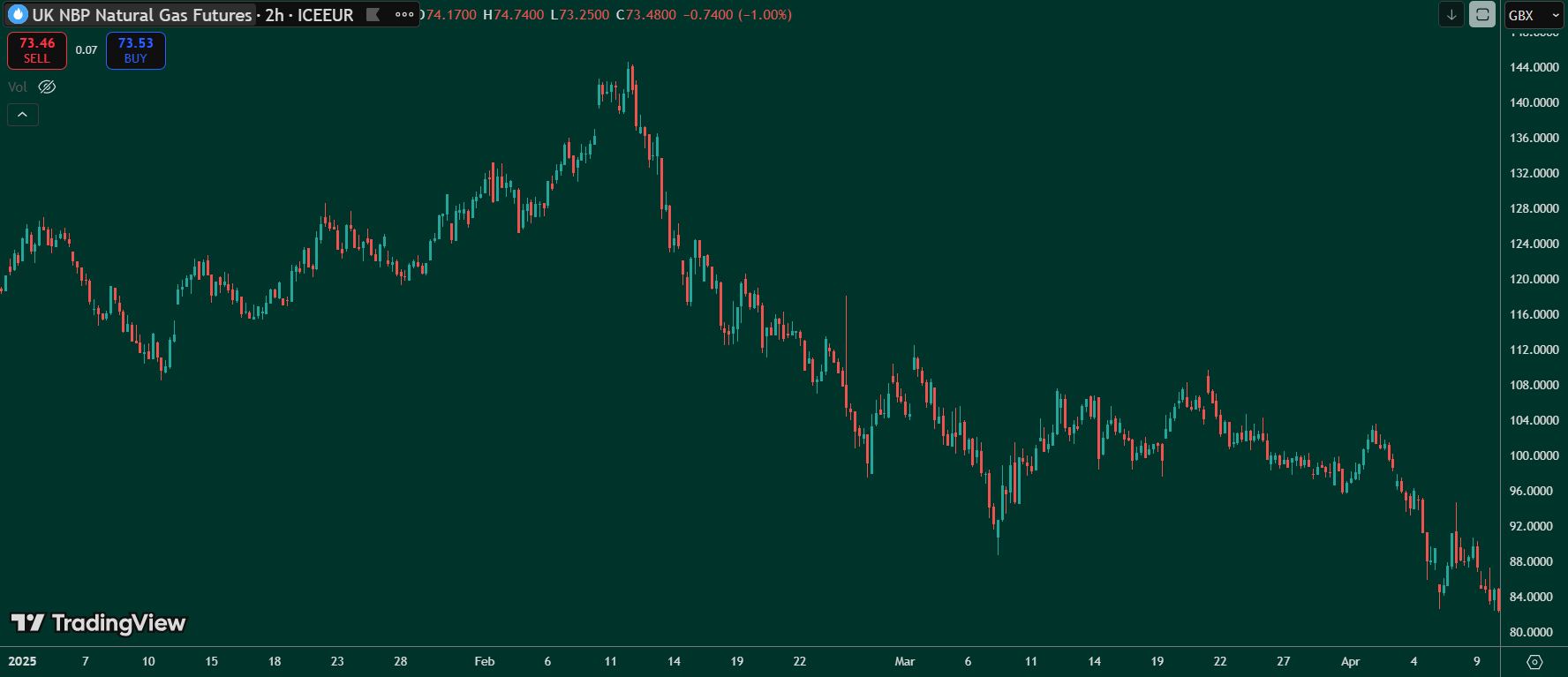
The year started with the UK recording its coldest temperature in 15 years and gas prices rising in the wake of Russian gas ceasing to flow into continental Europe. News of the US lifting their LNG export ban offered some respite, but prices failed to drop in the first month of the year after they had risen sharply in the final few months of 2024.


In February, milder-than-expected weather combined with the commencement of peace talks between Ukraine and Russia brough some optimism to the markets. This saw prices for Summer’25 gas and electricity drop by approximately 15%.


Prices continued to decline in March, although the EU issuing mandated gas reserve levels meant there would be an increased buying pressure which would keep prices propped up for the coming months.


Q2
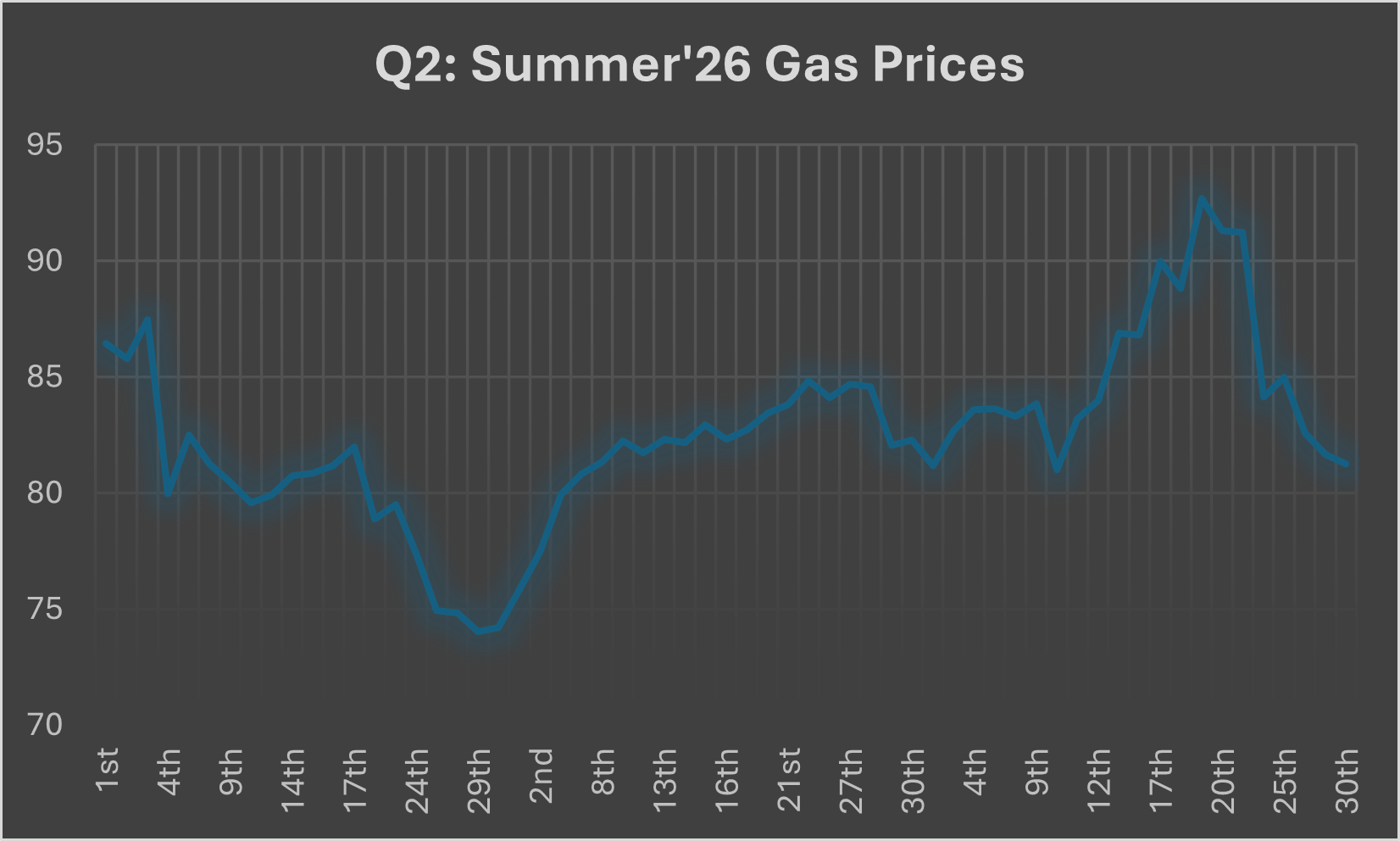

The trend of wholesale energy prices falling continued into April, where prices for Summer’26 gas fell by almost 15%.

This April price drop was largely due to unseasonably warm weather domestically, and the US imposing tariffs that caused production cuts which led to lower energy consumption internationally.

This meant that for a business set to consume 100,000 therms (2,930,713 kWh) during April-September of 2026, if they had purchased their gas for this period at the end of April, they would have saved approximately £20,000 compared to the prices at the start of January.

At this time, we acknowledged in our monthly review for April that:


 “the market is still volatile, and tariffs being repealed or increased conflict in Ukraine could lead to prices rising again.”


This was shown to be prescient as increased tensions between Ukraine and Russia, maintenance of Norwegian gas fields, and the potential of conflict between Israel and Iran caused prices to rise in May.

When we then stated that:


 “it seems as though multiple catalysts are in place that could drive prices up in the coming months... it seems that even further progress in Russian/Ukrainian peace talks may not be enough to cause another significant drop in prices…the market will likely react more sharply to any negative news impacting these supply chains.”


This proved to be the case as prices rose in June due to international conflicts threatening to disrupt global supply routes. Wholesale markets rose by 25% during the month, before news of a cease fire helped prices return to previous levels.


Q3
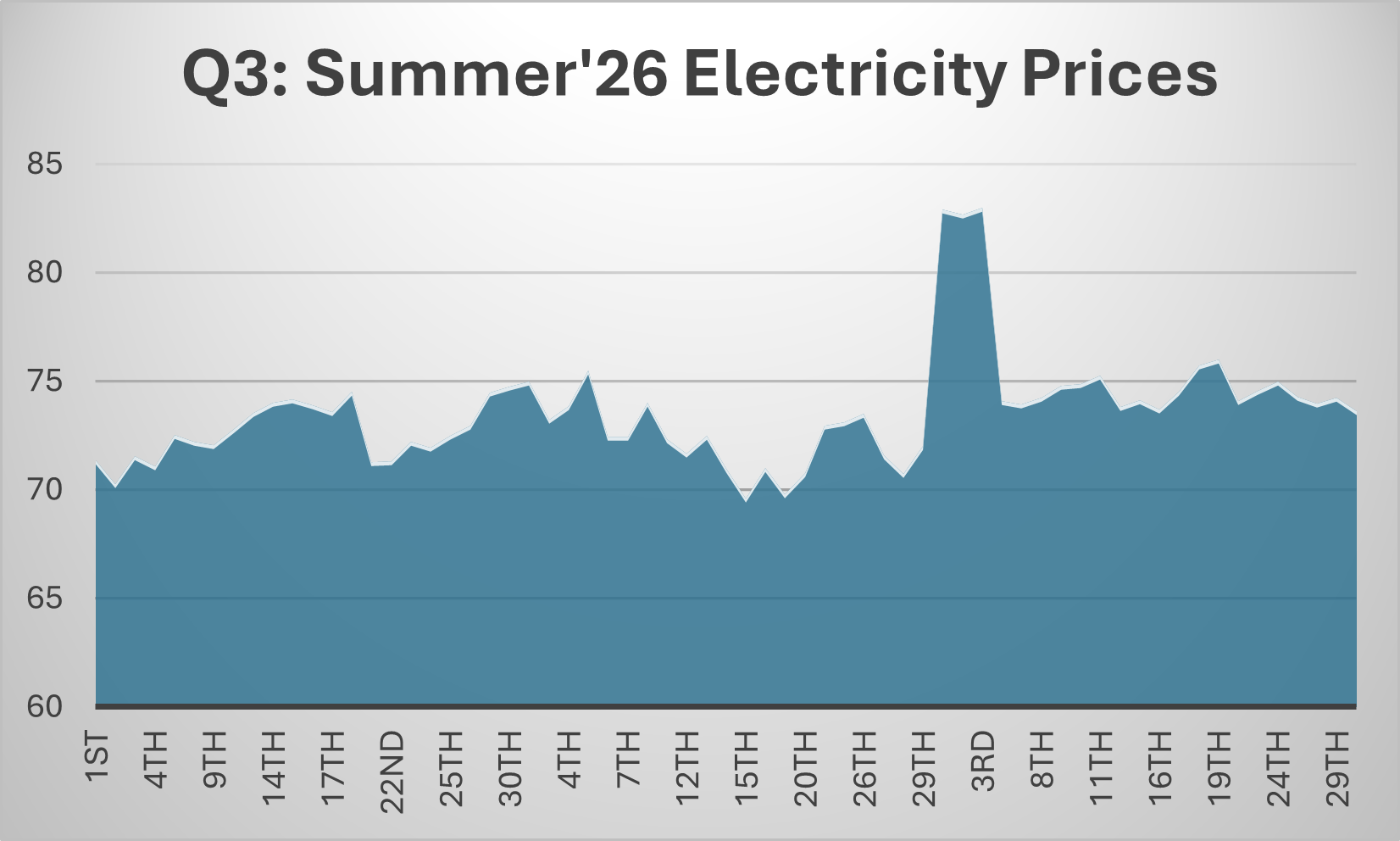

Prices remained volatile in July as fears increased about whether EU gas reserve goals would be met, however, prices began to fall again in August when data showed that most nations were set to hit their targets.

At the end of August, we wrote:


“ it appears that restrictions to supply from Russia will have a muted effect compared to 3 years ago. While this caps the potential for price rises, the possibility of Russian pipelines being re-opened to European markets still has the potential to lower prices.”


The markets would continue trading in a flat range throughout September, with little change in prices being observed. At this time – with the mandated buying coming to an end – it became clear that prices looked set to drop, and we stated as much in our September review:


“With European buying pressure dropping off and there being no clear, imminent threats to supply, it seems as though prices could be set to drop over the coming months.”


This would come to fruition in the final quarter of the year, when wholesale prices dropped significantly. Although, despite these drops in price, rising standing charges would mean few businesses would see the benefit of this decline.


Q4
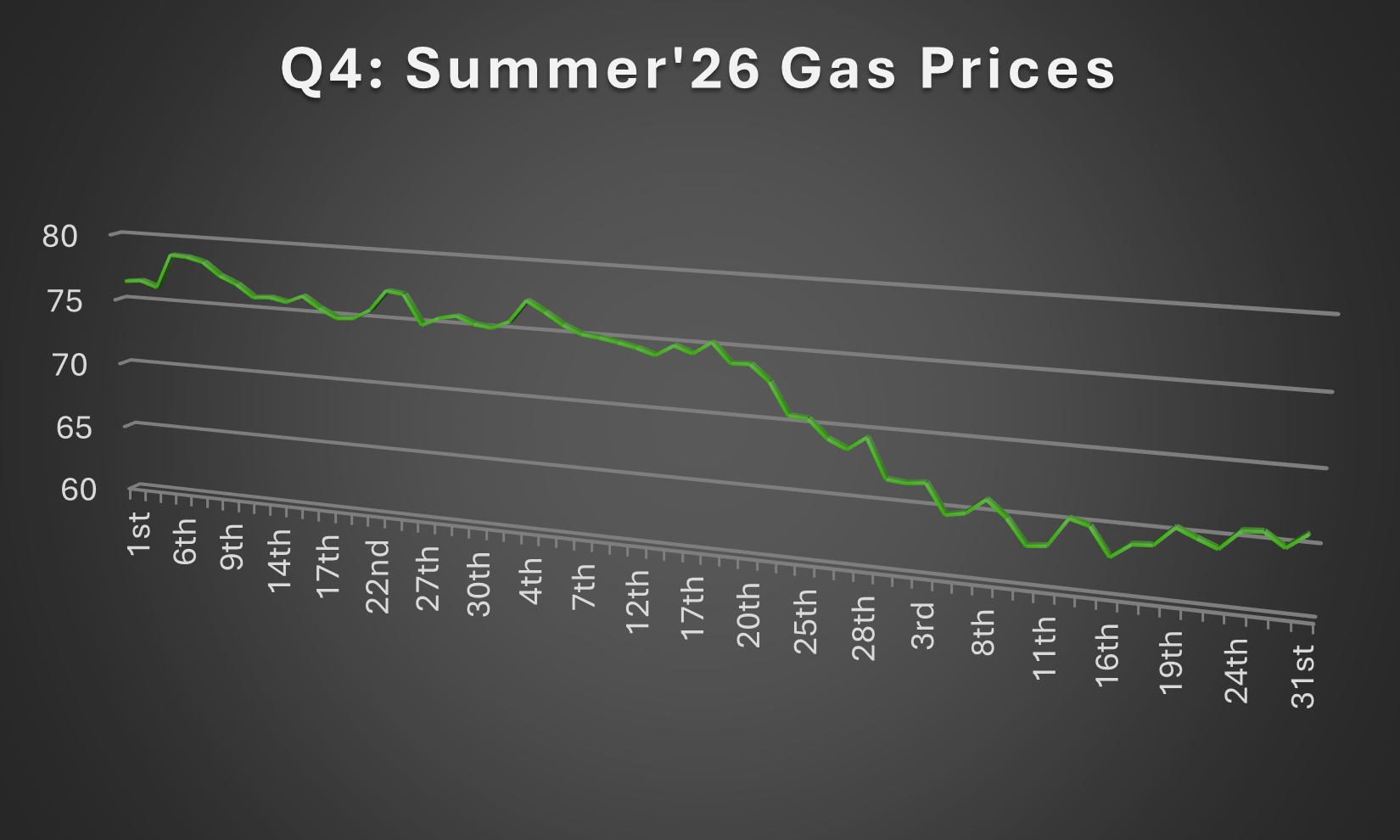

After a relatively uneventful October, prices began to fall during November, with wholesale gas prices reaching their lowest levels since July’24. After a budget that offered little relief to UK businesses hoping for assistance with their energy costs, further news of peace-talks between Russia and Ukraine did however offer some hope, as prices dropped on the back of this news.

With the European state buying pressure now removed, prices were able to hit their yearly lows as we entered December. Prices then continued to drop in the first week of the month before stabilising slightly as forecasts emerged of colder-than-expected weather for the end of December and early part of January.


At the end of December, it was confirmed that TUoS and DUoS prices would be set to significantly increase in April. For some businesses these can be charged as individual line items, but for others it will be added via their standing charge.


For the business looking to buy 100,000 therms of energy for Summer’26, the difference between the yearly high in February, and the low in December, equates to a difference of over £45,000. Further highlighting the importance of when to time your energy purchases.

For this period, gas prices had dropped over 30%, however, electricity prices had dropped by less than 5%. Historically there had been a stronger correlation between gas and electricity prices but this correlation seems to have been weakened by the percentage of the UK’s electricity now generated by renewables. This high volume of renewable generation has long-term positives but has also been largely responsible for the rise in non-commodity costs. The amount of work and investment necessary to update the existing grid infrastructure is the primary driver behind standing charges rising so significantly in recent years.


2026 Outlook

In the early part of the year, weather is set to be a key driver behind prices. Forecasts are suggesting that there will be an increased risk of storms and colder than usual weather up until the 20th of January, but after this we should see milder conditions. For those looking to renew contracts or make energy purchases in the early part of the year, February looks likely to be the sweet spot between poor weather conditions and European nations once again looking to replenish their gas reserves.


With the Suez Canal set to reopen, this offers increased shipping options and could lower transport costs, but any further military action in the Middle East would likely send prices higher.


Any peace deal between Russia and Ukraine that would allow for Russian gas flowing back into Europe would send prices lower, but this doesn’t seem likely to happen in the immediate future.


LNG exports are expected to increase with the US and Qatar both adding to their export capacity. Norway is also expected to increase their gas exports from 2025, meaning the supply side of the picture is looking healthy for the UK.


On the demand side, Chinese demand is expected to increase following a muted 2025--  as a result of US tariffs being imposed -- however, it seems likely they may be a major purchaser of energy from Russia and not necessarily in direct buying competition with European nations. They also have well-stocked coal supplies and don’t adhere to the same environmental guidelines as most European nations.
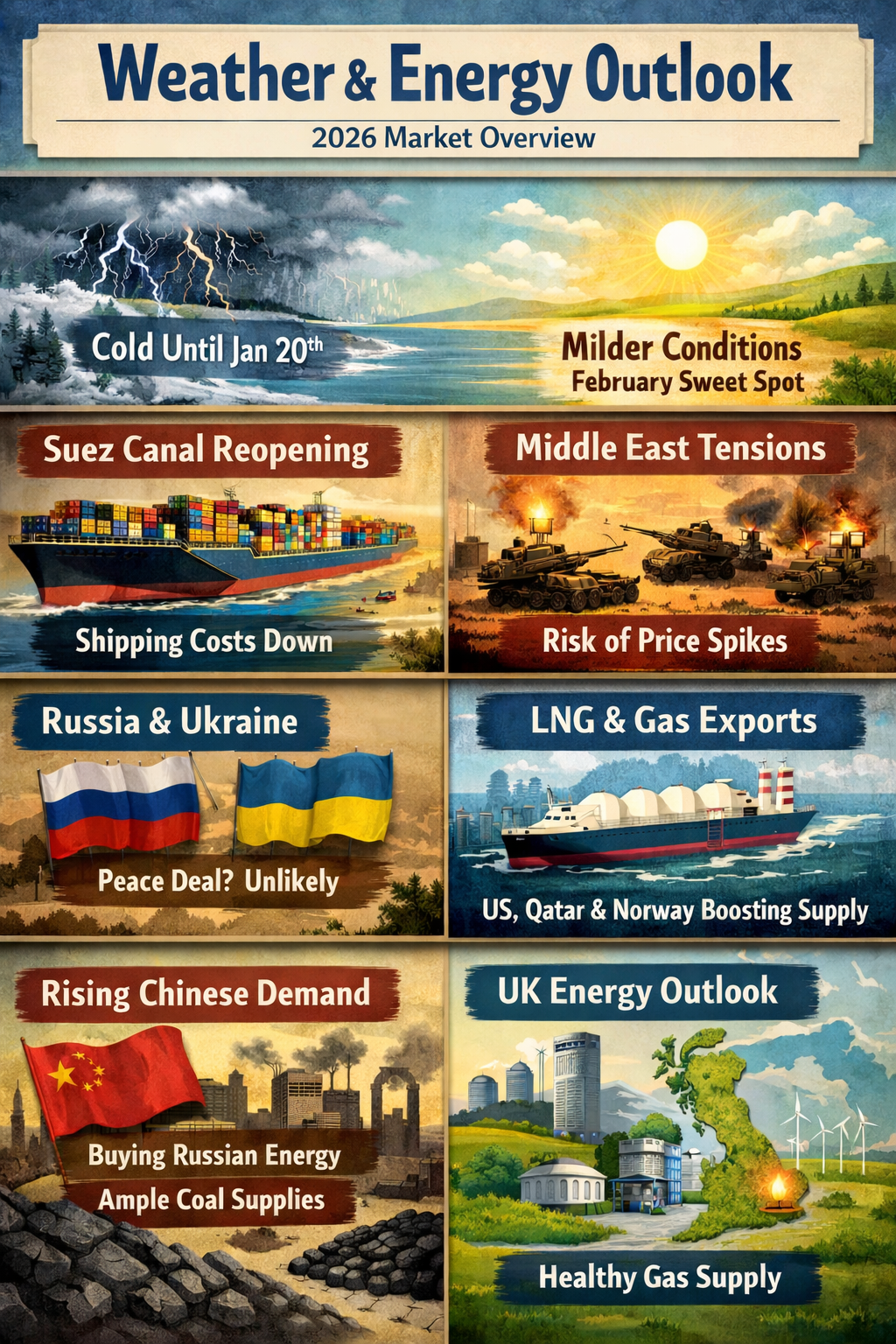
In summary, without geopolitics yet again having a strong influence on the markets, gas and electricity could see one of the most stable years in recent memory, with a slight decline expected. However, dismissing the possibility of geopolitical factors dominating the energy landscape seems overly optimistic, and constant adaptations to ever-changing global conditions will once again be a necessity.

It should also be noted that any drops in wholesale energy prices may be negated by the rising non-commodity costs and standing charges. From the 1st April, the new TUoS and DUoS rates will take affect, further increasing the energy costs for UK businesses, most notably for high-volume consumers.


If you want to keep up to date with the news impacting UK energy prices, we publish our monthly reviews on the first working day of the month, both on our website and on Linkedin.


And if you have a gas or electricity contract due to expire in the next year and would like us to advise you on the optimal times to obtain quotes, or if you would like assistance with any of your business energy needs, contact SeeMore Energy today for no obligation advice from a team of experienced professionals.
Contact Us

5 January 2026
By Adam Novakovic With the frenetic pace of the Christmas season and thoughts about whether the presents have been wrapped, if all of the Amazon parcels have arrived, and concerns over the turkey being sufficiently sized for the entire family, you may be forgiven for not having taken the time to track the energy markets this December. In our final monthly review of 2025, we will aim to bring you up to speed with how the energy markets are developing and what impact this is likely to have on British businesses.
10 December 2025
Ever since the Summer of 2021, energy prices have been above their historical levels. Whilst the initial spike created by the Russia/Ukraine conflict was short-lived, prices never fully returned to their pre-conflict levels. More recently, the first quarter of 2024 saw some reprieve as wholesale prices dropped, but prices rose by over 150% between February of 2024 and February 2025.
1 December 2025
By Adam Novakovic Whilst November’s budget may have disappointed businesses hoping for governmental assistance in the battle against high energy prices, the wholesale market offered some hope. With the mandated need for EU nations to replenish their reserves now in the rear-view mirror, buying pressure dissipated, and there were many positive stories that helped send prices downwards. The first half of the month saw small rises and drops that largely cancelled each other out, but from November 18 th through to the 28 th , wholesale gas prices fell approximately 12% and reached their lowest levels since July’24. There is normally a slight delay before the wholesale price drops are passed on to the end user, but for those with contract expiry dates in the next 6 months, the coming weeks may present opportunities to obtain quotes at rates more favourable than at any other point in 2025. One of the main reasons for optimism regarding future gas supplies is the peace talks being held between Russia and Ukraine. Any formal deal will almost certainly include a lifting of sanctions on Russian gas sales and provide a significant supply boost to the global market. However, there may still be obstacles to overcome before any peace plan is finalised with Ukraine and Russia both unwilling to concede territory.
26 November 2025
By Adam Novakovic With many British businesses struggling to navigate the challenges that soaring energy costs have had on their ability to compete internationally, there was a sense of optimism that the government would introduce measures designed to alleviate the pressure that many companies have been burdened with. As we close out 2025, Energy costs are typically within the top 3 overheads for any business operating from commercial property & rising costs are fast becoming the most significant risk to sustainability, which has far wider impacts to the UK economy. Unfortunately, no such measures were forthcoming and the announcement fell flat for those that need it most. Hopes of expanding the NCC or EII discounts to further sectors, or reducing VAT levels on gas and electricity, turned to disappointment, as only minor changes were announced. One such change was the government’s decision to abolish the Energy Company Obligation (ECO) and to fund a substantial portion of Renewables Obligation costs through general taxation. Although these measures are aimed at easing pressures on domestic consumers, they also remove some of the cost drivers within the wider energy system. With fewer policy-driven levies feeding into wholesale and supplier operating costs, businesses may experience a modest dampening effect on future price rises, although this is unlikely to translate into immediate or substantial reductions in commercial tariffs. The Budget did reinforce the government’s commitment to green investment through its updated Green Financing Framework, which will fund green expenditures that tackle climate change, rebuild natural ecosystems and support jobs in green sectors. While this is unlikely to have any short-term impact on energy costs, one small positive -- when compared to previous green schemes -- is that this programme will be funded by the issuance of gilts and bonds, rather than passing the cost on to suppliers who invariably pass the cost on to the end users.  Despite the need for assistance with rising energy costs, small and medium-sized enterprises (SMEs), many of which remain exposed to fixed-term contracts negotiated during the recent price spikes, are not going to see any immediate relief, and the accountability seems to remain solely at the door of the business owners to find their own ways to minimise costs.
23 November 2025
The ever-increasing standing charge By Adam Novakovic For UK businesses, cutting energy consumption is no longer enough to keep bills under control. Even companies that have invested in LED lighting, insulation, or energy-efficient equipment are finding that a large part of their energy expenditure is the result of a different cost entirely: the ever-increasing standing charge. In some cases, businesses using under 150,000 kWh per year are now being charged £40–£50 per day in electricity standing charges alone. That’s £1,200–£1,500 per month, or £14,500–£18,000 a year, before a single unit of electricity is used. What are standing charges? A standing charge is the fixed daily fee you pay for your utilities before you’ve used a kWh of gas or electricity. The intention behind the standing charge is that it covers aspects of the energy network that require funds regardless of usage levels, such as: National Grid and local network costs Supplier operating costs and smart metering Some industry and government policy schemes A recent government consultation found that around half of the typical electricity standing charge is made up of network costs alone, with a further quarter linked to operating and industry costs.
3 November 2025
October Review By Adam Novakovic In the month of Halloween, October energy price movements were free of jump-scares. Whilst prices moved up slightly at the start of the month, they marginally decreased throughout the remainder of October. Ending the month slightly below the levels seen at the end of September. The expectation this month was that European gas reserves would be the key story impacting energy prices. The European Network for Transmission System Operators for Gas (ENTSOG) released their report on the Winter supply outlook. This confirmed that Europe is well prepared for the coming winter, with 83 % gas reserves recorded as of the 1 st of October, and infrastructure resilient enough to meet demand without Russian pipeline gas. Their projections had Europe ending the winter season with over 30% storage even in the most severe scenarios. There is also the expectation that any unforeseen supply disruptions can be mitigated through increased LNG imports -- supporting the EU’s goal of phasing out Russian gas while emphasising continually reducing demand. During the first week of October Russia launched a wave of drone attacks against Ukraine -- the largest since the war began. These strikes have damaged Ukrainian gas production and left storage at 42% of capacity. This has forced Ukraine to look at importing large quantities of LNG from Europe this winter. With the deal that brought Russian gas to Europe now expired, Europe faces added demand pressure. This comes despite Europe significantly reducing Russian gas imports and increasing LNG imports from other nations. With there currently being a large quantity of LNG available for importation, and with EU gas reserves being in a healthy position, it seems as though further conflict may not have a large impact on energy prices. This could change however if Europe were to experience a particularly cold winter.
30 October 2025
With government-imposed charges making up an increasing percentage of business energy bills, it is becoming difficult for many UK industries to remain competitive in international markets. This led to the introduction of the British Industry Supercharger (BIS). A scheme for energy-intensive businesses that aims to counteract many of the government-imposed environmental levies and the rising transmission charges. In this article, we cover how it works and what your business needs to know to benefit from it. What is the British Industry Supercharger? Launched on the 1st April 2024, the British Industry Supercharger is a strategic package of relief measures aimed at energy‐intensive industries (EIIs) such as steel, metals, chemicals, cement, glass and paper. The aim is to reduce electricity non‐commodity costs so UK foundational industries can compete with businesses in nations with lower energy costs. The BIS is comprised of 3 sections: 1. Relief from Renewable Levies This provides businesses with exemptions from paying Renewables Obligation (RO), Feed-in Tariff (FiT), and Contracts for Difference (CfD). These charges were added to invoices in order to fund green-power generation. Under the Supercharger, eligible EIIs can receive up to 100% exemption from these charges. 2. Network Charging Cost Compensation This offers discounts on electricity network charges - including Transmission Network Use of System (TNUoS) and Distribution Use of System (DUoS) fees. These fees cover the cost of maintaining the national grid and distribution networks, but can represent a large proportion of industrial energy bills. The BIS introduces a Network Charging Compensation (NCC) mechanism, reimbursing eligible firms for around 60% of these costs. 3. Capacity Market Exemption The scheme offers eligible business a full exemption from Capacity Market charges. The Capacity Market is funded through indirect charges on electricity bills with the aim of funding generators to ensure they are available during supply-peaks.
21 October 2025
Why UK Energy Prices Keep On Rising… And what it means to manufacturing and engineering companies over the next few years Over the past decade, UK energy prices have changed dramatically. Not only in terms of overall cost but also in how those costs are made up. Ten years ago, the largest part of a business electricity bill came from the commodity element: the wholesale price of electricity. Non-commodity charges -- often used to support the infrastructure of the electricity grid or government energy policies -- were relatively modest. In 2013, the typical breakdown of electricity costs for a business user was around 60–65% commodity and 35–40% non-commodity. Today, that picture has flipped. For many manufacturers, non-commodity charges now make up over 60% of the total bill, with the non-commodity percentage of the bill increasing each year. This shift explains why energy bills have remained stubbornly high, even during periods when wholesale prices fell. Grid reinforcement, renewable subsidies, and balancing costs have grown year on year, with these costs baked into every unit of power consumed, regardless of wholesale prices.
14 October 2025
In the last decade, over 50 UK energy suppliers have gone out of business. With Tomato Energy being issued with a provisional order this week, it seems as though their name will be the latest to be added to the list of defunct suppliers including Bulb, Avro, and Spark Energy. For customers of a supplier that is on the brink of going out of business, this can be a scary time, but there is a process in place to ensure they are not at risk of losing their supply. Who is responsible? OFGEM (The Office of Gas and Electricity Markets) are a non-ministerial government department tasked with regulating the energy markets and networks. In cases where a supplier goes out of business, OFGEM provide a safety net to ensure that customers supply won’t be disrupted. What is the process? OFGEM may elect to appoint an administrator. If this is the path they choose, then no action is necessary from the supplier’s customers. At some point, the administrator may choose to shut down the supplier, at which point, all existing customers will be moved to a new supplier of the administrator’s choosing.
6 October 2025
Market-Wide Half-Hourly Settlement (MHHS) What is MHHS? MHHS stands for Market-Wide Half-Hourly Settlement. Currently, most electricity is billed based on estimates or meter reads that can be provided monthly, quarterly, or sporadically. With MHHS, electricity consumption will be accounted for and billed in 30-minute blocks. The idea is that with more precise, time-based data, suppliers and networks can match supply and demand more accurately. This helps reduce waste and allow more flexibility in how electricity is used across the system. Who does it apply to? Previously, only large industrial and commercial users needed to have half-hourly meters, but MHHS is intended to apply across the whole electricity market in Great Britain. This includes domestic consumers, small businesses, large industrial users, and everything in between. That means most electricity users will be indirectly affected, even if they don’t see anything change in how their meter looks, the rules behind billing and settlement will shift behind the scenes.