The British Industrial Competitiveness Scheme (BICS)

15 January 2026

The British Industrial Competitiveness Scheme (BICS):

What manufacturers need to know before signing their next contract and how we can help

By Adam Novakovic


For many energy-intensive UK businesses, rising gas and electricity costs have been an increasingly uncomfortable thorn in their side. Even as wholesale prices have dropped, new line items to fund green-initiatives and ever-increasing standing charges have harmed the competitiveness of British businesses.


What is the British Industrial Competitiveness Scheme?

As a response to these rising costs, the government is now consulting on the British Industrial Competitiveness Scheme (BICS). The aim of this scheme is to support eligible manufacturing businesses by exempting them from the indirect costs of three charges that suppliers typically pass through to end users:


  • Renewables Obligation (RO)
  • Feed-in Tariffs (FiTs)
  • Capacity Market (CM)


The expectation is that this should reduce electricity costs by approximately 4p/kWh, saving many mid sized manufacturers between £150,000-£300,000 per year. While consultation is on-going, the plan is for this scheme to be introduced in April 2027.


Who is likely to be eligible?

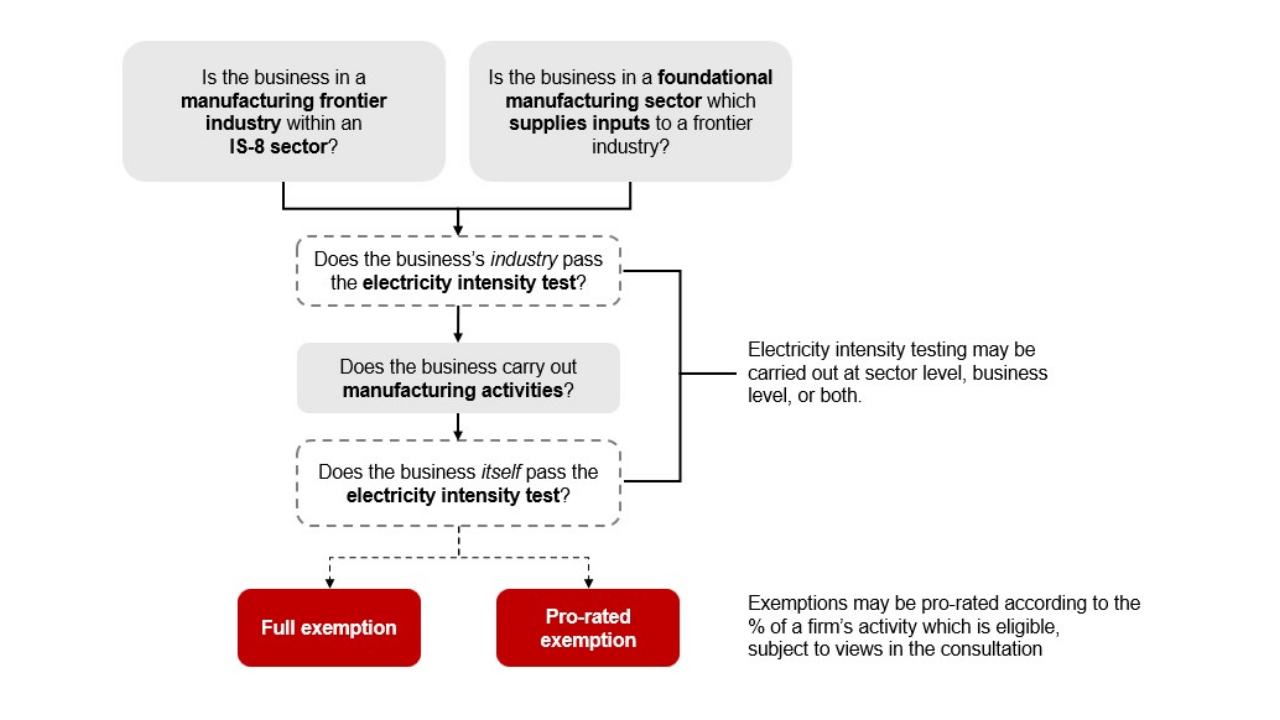
The BICS is currently in the consultation stage and awaiting confirmation of details. However, the scheme is expected to be available to business that are:

Manufacturing frontier businesses within an IS-8 sector

Manufacturing foundational industries supplying important inputs into those frontier sectors

Electricity Intensive Manufacturers


Eligibility is expected to be assessed using a combination of SIC codes (what the business is registered as) and HS codes (the goods/products manufactured).

The consultation also acknowledges that many businesses produce a combination of eligible and non-eligible goods. For these businesses, it is planned that the discount will be pro-rated based on what percentage of production is related to eligible products.

Image from British Industrial Competitiveness Scheme: consultation on scheme eligibility and approach - GOV.UK


How BICS interacts with the British Industry Supercharger

For businesses already receiving relief from the British Industry Supercharger (BIS), the interaction matters.

Both schemes are designed to reduce industrial electricity costs, and both include exemptions from RO, FiTs and CM.

However, BIS also includes additional reductions for Contracts for Difference-related costs and network charging compensation via the NCC scheme. As the same exemptions can’t be applied twice, businesses eligible for Supercharger support will be unable to benefit from BICS, and businesses that meet both sets of criteria would typically be advised to apply for BIS due to the higher support level.


The consultation also signals that BICS electricity-intensity thresholds will be lower than BIS --BIS is 7% at sector level and 20% at business level -- allowing many businesses that don’t currently qualify for the Supercharger to benefit from the British Industrial Competitiveness Scheme.


Why your electricity contract matters

Unlike other schemes where discounts are automatically applied, with BICS, your contract structure is vital in ensuring you receive the discount.


If you lock into a contract that fixes non-commodity components beyond April 2027, you could end up in a situation where you’re still paying for charges that the BICS is designed to remove.


Ensuring that the non-commodity costs in your contract are ‘pass-through’ will make sure that your business receives the discounts.


What can be done now

Even though BICS doesn’t start until 2027, the time to begin preparing is now:


  • Check likely eligibility early: identify your SIC code and the HS6 codes for the products you manufacture.
  • Review your meters: ensure you can link eligibility evidence to the appropriate sites and MPANs.
  • Adjust your budgets: model what a £35–£40/MWh reduction in electricity costs could mean for your business.
  • Check your contract: if your next renewal runs beyond April 2027, make sure the terms don’t block you from receiving reductions.


How we can help

At SeeMore Energy, we can support with:


  • Eligibility checks (reviewing SIC/HS codes)
  • Savings forecasts across sites and meters
  • Contract reviews and renewal strategy, specifically to protect your ability to benefit from levy changes in 2027
  • Ongoing invoice and non-commodity validation (checking that you are currently paying the correct non-commodity costs and ensuring the BICS discount is applied once the scheme is active)


By sharing a description of what you manufacture, and a recent electricity invoice, we’ll be able to give you a clear view of whether you’ll be eligible for the scheme and what BICS could realistically be worth to your business once it goes live.

Contact us today for a free review of what BICS could mean to your business, or for help with any of your energy needs.


Contact Us

2 March 2026
February 2026 Review When writing monthly reviews, I research and make notes throughout the month that allow the final writing process to be straightforward, with all key points already in place. For this month, almost all of my notes had to be torn up and thrown away on the final day of February when the US declared war on Iran. It is rare that one story has the ability to cause a seismic shift of such magnitude that all other news affecting energy prices seem irrelevant by comparison, but – for the first time since the Russia-Ukraine conflict began – we have a geopolitical event of that level. Electricity prices for the Summer’26 season had dropped as low as £65.66/MWh in mid-February, but opened up at £79.70/MWh this morning, showing an over 20% increase from this low point. Meanwhile, wholesale UK gas prices are trading 25% higher than when the market closed on Friday. For a business set to consume 10,000MWh of electricity during the summer, this represents a price increase of over £140,000 when comparing today’s price to the February low point.
24 February 2026
Where Does My Energy Come From? It’s a simple question, but the answer is more complex than many businesses realise. When you flick a switch or power up your operations, the electricity and gas you use is the end product of a vast, interconnected system of generation, infrastructure, global markets and regulation. Understanding where your energy comes from isn’t just a curiosity, it’s commercially relevant. Electricity: A Real-Time Balancing Act In the UK, electricity is generated from a mix of sources. The primary contributors today include: Gas-fired power stations Wind (onshore and offshore) Nuclear Solar Interconnectors importing power from Europe Unlike gas, electricity must be generated and consumed in real time. Supply and demand are constantly balanced by the system operator, ensuring the grid remains stable. If supply ever falls short, then prices can spike. In recent years, numerous grid updates have taken place to ensure that renewable energy can be added to the grid and quickly transported. While many businesses purchase “renewable” tariffs, this doesn’t mean the electricity you receive was generated by renewable sources. Electricity on the grid is pooled, so you don’t receive electrons directly from a specific wind farm. Instead, suppliers match your usage with renewable generation certificates (REGOs), demonstrating that an equivalent amount of green power has been produced. For larger energy users, the mix of generation matters because it directly impacts wholesale pricing. An evening with low wind output, for example, can significantly increase reliance on gas-fired generation, therefore increasing exposure to the wholesale price of gas. Gas: A Global Commodity Gas plays two roles in the UK energy system: Heating homes and businesses directly, and fuelling many power stations that generate electricity. The UK produces some natural gas domestically from the North Sea, but production has declined over the years. Today, a significant proportion of supply is imported via: Pipelines from Norway Liquefied Natural Gas (LNG) shipments – particularly from Qatar and the US Interconnectors from continental Europe Because gas is traded globally, UK prices are influenced by international supply and demand dynamics. Events in Europe, Asia or the US can directly affect what UK businesses pay. This means geopolitical events such as the threat of war in the Middle East can cause prices to rise sharply . Renewables and the Energy Transition The UK’s generation mix has changed dramatically over the past decade. Coal has been phased out, while wind and solar capacity have grown significantly. This shift brings both opportunity and volatility. Renewable generation lowers carbon intensity and reduces exposure to fuel imports. However, because wind and solar output depend on weather conditions, short-term price fluctuations have become more pronounced. For businesses with flexible procurement strategies , understanding this dynamic can create opportunities to secure more competitive pricing. Why It Matters for Your Procurement Strategy Where your energy comes from can influence many other aspects of your energy strategy, including: Wholesale market pricing Carbon reporting obligations Contract structures Long-term risk exposure Understanding where your energy comes from has never been more important for UK businesses. If you want to understand how the current generation mix and global gas markets are affecting your upcoming renewals, SeeMore Energy can help you interpret the landscape and see what options are currently available for you.
23 February 2026
How Do I Find Out Who My Energy Supplier Is? This is a surprisingly common question, particularly if you’ve just moved into a new property, taken over an existing site, or inherited responsibility for energy procurement.  If you don’t know who supplies your electricity or gas, don’t worry. There are clear steps you can take to find out quickly and avoid unnecessary delays, billing issues, or out-of-contract rates. 1. Check Recent Bills or Tenancy Documents If the property has been occupied recently, the simplest place to start is with a previous energy bill. This will confirm: The supplier name Your account number The supply address Your MPAN (electricity) or MPRN (gas) If you’ve just moved in, your landlord, managing agent, or outgoing tenant may also be able to confirm the supplier. 2. Use the National Databases If no bills are available, you can use the industry’s central databases. For electricity , contact your local Distribution Network Operator (DNO). In England, Scotland and Wales, you can find your DNO via the Energy Networks Association website . They can confirm your current electricity supplier and provide your MPAN. For gas , you can contact the Meter Point Administration Service (MPAS) via the Xoserve database, or use the find my supplier tool. These services are free and typically provide confirmation immediately. 3. Contact the Meter Operator In some cases, particularly with larger commercial sites, your appointed meter operator may be able to confirm the registered supplier. This is more common where contracts have been arranged historically through brokers or third parties. Common meter operators include IMServ, Npower, and Stark. 4. Act Quickly to Avoid Out-of-Contract Rates If you’ve taken over a site and haven’t agreed a contract, you could be placed on deemed or out-of-contract rates . These are usually significantly higher than negotiated market rates. Confirming your supplier allows you to: Request historic consumption data Understand your current contract status Avoid unexpected charges Begin procurement discussions Why It Matters Knowing your supplier isn’t just administrative, it’s commercially important. Without clarity on who supplies your energy, you can’t properly review your costs, assess renewal timing, or manage market exposure. If you’re unsure where to start, or if you’ve identified your supplier but don’t know what contract you’re on, SeeMore Energy can help you interpret the position and plan your next steps with confidence. Getting clarity is the first step towards controlling your energy strategy.
18 February 2026
The Capacity Market: An untapped revenue source With wholesale markets volatile and network costs rising, many businesses are looking at strategies to reduce energy spend. In addition to lowering costs, there are ways that large consumers of energy can monetise their existing energy set up. By selling back unused capacity via the Capacity Market (CM), businesses can generate tens of thousands of pounds each year, without having to make any material changes to how they run their operations. What is the Capacity Market? The UK Capacity Market was introduced in 2014 to safeguard security of supply. The CM has two main objectives: Incentivise new sources of generation that can prevent issues on the demand-side. Provide a last-resort mechanism to prevent electricity shortages during times of system stress. Administered by National Energy System Operator (NESO), the scheme pays providers for being available to deliver capacity during periods of system tightness. Businesses can receive payments, not for generating electricity, but for committing to reduce demand or increase supply if required. Capacity is secured through annual auctions (one year ahead and four years ahead), which set a £/kW price. Once contracted, participants receive an availability payment in return for meeting testing requirements and being ready to respond to a system stress event. Since the CM’s inception, there has never been a full system stress event triggered. Although precautionary notices have been issued and subsequently stood down – normally within 2 hours of being issued. How Can Businesses Make Money from It? For many businesses, the opportunity lies in Demand Side Response (DSR) . If a business can demonstrate that it is capable of reducing load during a stress event -- even for just 30 minutes -- that reduction can be contracted into the Capacity Market. The process for this is: Historical half-hourly data is analysed to establish normal usage. Periods where usage dropped materially (e.g. shutdowns, maintenance, early finishes, seasonal dips) are identified. The difference between normal usage and the reduced period becomes the site’s deliverable capacity. This capacity is aggregated with other businesses into a CM Unit (CMU) and entered into the auction. Payments are then made quarterly in arrears for being available.
12 February 2026
Forecasting annual electricity and gas consumption is one of the most important -- and often underestimated -- stages of the procurement process. While timing the wholesale market and contract structure typically receive the most attention, the accuracy of the consumption forecast can have a large influence on overall energy costs. Suppliers price risk based on expected volumes, network charges are dictated by usage patterns, and internal budgets depend on accurate projections. Without a reliable forecast, organisations expose themselves to avoidable financial and contractual risk. How Consumption Forecasting Works Forecasting begins by analysing historical usage. Half-hourly electricity data, meter reads, and seasonal profiles provide a baseline that shows how a site behaves over time. This historical data is then adjusted to account for known changes, such as production increases, machinery upgrades, operational reductions, or energy efficiency projects. For larger or more complex organisations, forecasting may involve modelling peak demand, load shape, and expected operational shifts across multiple sites. The aim is not simply to estimate an annual total, but to understand when and how energy will be consumed throughout the year. That detail becomes particularly important when selecting contract structures or assessing exposure to network charges. How It Impacts Budgeting Energy often represents a significant operational cost, particularly for manufacturers and other energy-intensive users. Accurate forecasting enables finance teams to build realistic budgets and avoid the shocks of unexpected costs. Reliable forecasts also allow organisations to model different pricing scenarios. Understanding likely consumption enables comparison between fixed contracts and flexible purchasing strategies . It also supports long-term planning by quantifying the financial impact of operational changes or sustainability initiatives.
5 February 2026
Why it’s important your energy bills are in the correct company name For many businesses, energy bills aren’t reviewed with a high-level of scrutiny. As long as the meter is live and the lights stay on, the paperwork often goes unquestioned. However, having electricity and gas bills issued in the correct legal company name is more important than many organisations realise. Failing to ensure that your invoice is correctly addressed can create unnecessary risk and cost. How it can impact your business Energy contracts are signed with a specific legal entity, not a trading name or group brand. If the company name on the bill does not match the Companies House records, the contract may not accurately reflect who is legally responsible for the supply. This can cause problems in the event of disputes with the supplier, changes of tenancy or site ownership, and contract renewal or termination. In some extreme cases, suppliers can refuse to amend or even enforce contracts where the named party is incorrect. Affecting credit checks and pricing Suppliers assess risk using the company name registered on the account. If this is incorrect or outdated: Credit checks may fail or be delayed Higher security deposits may be requested Less competitive pricing may be offered For growing businesses, group structures or recently incorporated entities, this can result in paying more than necessary for energy, simply because the account information isn’t aligned. Delaying contract changes and site updates Something as simple as renewing a contract, adding meters, or updating a supply address can become complicated if the company name is wrong. Common scenarios include: Sites transferred between group companies Trading names used instead of legal names Businesses that have changed structure or ownership Each of these can trigger lengthy data disputes between suppliers, distributors and settlement systems, often delaying changes by weeks or months. Issues with VAT, levies, and exemptions Where VAT exemptions exist, the name on the invoice is required to match the name of the business that has the exemption. There are numerous government schemes that offer businesses relief from specific environmental levies and non-commodity charges . Many of these schemes – such as the British Industry Supercharger – are applied to companies with eligible SIC codes. If the business name is incorrect, then the SIC code cannot be verified and the business may end up missing out on the exemption. Future Contracts When tendering energy contracts, suppliers rely on accurate account data. Incorrect company names can slow down the quoting process, result in quotes being withdrawn, or lead to errors in contracts or start dates. For businesses managing multiple sites, this becomes even more critical. How we help businesses get it right As an energy broker, we regularly see cost and risk created by something as simple as incorrect account information. We help businesses:  Verify company names against Companies House Correct supplier and industry records Manage name changes during restructures or acquisitions If your business requires help with ensuring that your invoices are being issued in the correct name, contact us today and one of our experienced team can assist with all of your energy needs.
5 February 2026
Rising TNUoS and DUOS charges By Adam Novakovic T.S Eliot once said that “April is the cruellest month” and in terms of the prices many businesses pay for their electricity, his quote is prophetically true. While he may not have envisioned rising TNUoS and DUoS costs being the reason for the starkness of the month, for many British businesses, the rise in non-commodity charges that take effect from April 1 st will add unwanted and unneeded extra costs to their energy bills. From the beginning of April, businesses across the UK will see significant increases in two major components of their energy bills: Distribution Use of System (DUoS) and Transmission Network Use of System (TNUoS) charges. These network charges are becoming an increasingly large part of business energy bills -- especially for companies that operate in energy-intensive industries. DUoS & TNUoS, and Why They Matter Both DUoS and TNUoS are network charges applied to electricity bills. As non-commodity charges, they are not related to the cost of energy itself: DUoS charges cover the cost of running, maintaining and reinforcing local distribution networks that carry power to sites. They are paid as a standing charge (in p/day), a capacity charge (in p/kVA/month), and in red/amber/green unit rates – depending on the time of consumption. TNUoS charges fund the high-voltage transmission network operated nationally. This is applied as a standing charge (in p/day). For many businesses, these line items are already making up over a third of their total electricity costs . How these charges change from April 1 st 2026 TNUoS The TNUoS rate that businesses pay is set by NESO (National Energy System Operator). How much a meter is charged per day is dependant on the assigned TCR band . For sites with lower expected consumption, they will be grouped in a lower band, whereas the largest consumers will be in the higher bands and they will be charged more.
1 February 2026
By Adam Novakovic January began with a sense of optimism. The new year brought hopes that energy prices could soon return to levels not seen since 2021, wholesale prices were falling and large quantities of new LNG were scheduled to be available for import during 2026. However, events that transpired during the first 31 days of the year have caused prices to rise and have sent waves of fear throughout the energy markets. The month began with a wave of cold weather leading to above-expected gas consumption. An Arctic blast combined with Storm Goretti brought temperatures down to below -10°C and led to gas power stations being needed to make up the shortfall, causing an uptick in wholesale gas prices.
30 January 2026
What is the Weighted Average Price (WAP) in energy? In the UK energy market, Weighted Average Price (WAP) refers to the average price paid for electricity or gas over a period of time, weighted by the volume bought at each price point. For those on flexible energy contract, the WAP represents what the unit rate will be when multiple purchases were made for the same period. In other words, it answers the question: “What did we actually pay for our energy once all purchases and volumes are taken into account?” This makes WAP far more meaningful than a simple average, especially in volatile markets. How WAP works in practice Energy prices move constantly. Businesses, particularly those on: Flexible contracts Basket or portfolio products Pass-through arrangements often buy energy in multiple tranches at different times and prices. For example: 40% of energy bought at 10.0p/kWh 30% bought at 12.0p/kWh 30% bought at 9.0p/kWh The WAP reflects the price-weighted impact of each purchase, giving a single unit rate that reflectsthe real cost exposure. Why WAP matters to UK businesses 1. It reflects real procurement performance WAP shows how effective your buying strategy has been, not just whether the market went up or down, but how your timing and volumes performed. 2. It’s essential for budgeting and forecasting Using WAP allows businesses to: Accurately forecast energy spend Compare performance year-on-year Avoid misleading headline prices This is especially important for manufacturers and high-consumption sites where small price differences materially impact costs. WAP vs fixed prices Fixed contracts : WAP is locked in at the point of contract Flexible contracts : WAP evolves over time as more volume is bought This means WAP can improve with smart market timing and deteriorate if exposure is unmanaged. For those on fixed contracts, it can be vital that portfolios are being managed by a person or group with experience and expertise in energy markets. Ultimately, the strategy of when and how much to buy is just as important as the market itself. WAP as part of your purchasing strategy Weighted Average Price is the truest reflection of what your business actually pays for energy. Understanding it is critical to controlling cost risk in volatile markets. For larger SMEs and energy-intensive businesses, having a clear energy purchase strategy and having this strategy communicated through regular reporting can be vital for forecasting future energy costs. If your business would like assistance with understanding the current state of your portfolio, or advice on purchasing and management strategies, contact us today to see how we can help lower your electricity and gas costs and help you See More of the hidden value in your energy portfolio.
29 January 2026
Meter types explained (LV, HV and EHV) For many businesses, electricity is treated as a fixed overhead -- something that cannot be changed. But in reality, how your site is connected to the electricity network can significantly influence what you pay , and many organisations are unknowingly on a setup that no longer suits their operations. Whether your supply is Low Voltage (LV), High Voltage (HV) or Extra High Voltage (EHV) impacts network charges, flexibility, and future growth. Understanding the difference could be the key to reducing costs and avoiding any unpleasant surprises. Low Voltage (LV): common, simple — and often overlooked Low Voltage (LV) supplies electricity at up to 1,000 volts and is the most common connection type for SMEs, offices, and retail units. LV customers usually benefit from: Straightforward billing Lower DUOS standing charges Minimal technical involvement However, simplicity can mask inefficiency. As businesses grow, extend operating hours or add energy-intensive equipment, LV sites can find themselves paying disproportionately higher network charges as red and amber unit charges make up a higher percentage of the costs. If your electricity costs have risen faster than your usage, your meter type could be part of the reason. High Voltage (HV): complexity that creates opportunity High Voltage (HV) connections operate between 1,000 and 22,000 volts and are typically used by manufacturers, large warehouses and energy-intensive commercial sites. HV supplies bring: Higher capacity charges Greater exposure to kVA related costs More detailed half-hourly consumption data While this can appear daunting, it also creates opportunity. Businesses that understand how and when they use electricity can actively influence costs, often achieving savings that are simply unavailable at LV. Many HV customers pay for more capacity than they need --or the wrong capacity altogether -- without realising it. Contact us today and we can conduct a kVA review that could potentially save £10,000s annually. Extra High Voltage (EHV): where energy becomes strategic Extra High Voltage (EHV) applies to supplies above 22,000 volts and is reserved for the UK’s largest electricity users. At EHV level: Network charges are highly bespoke Costs are closely linked to site-specific infrastructure Small demand changes can have large financial impacts For these businesses, electricity is not just a utility, it’s a strategic cost driver that requires ongoing oversight. Without regular review and proactive management, EHV sites can sleepwalk into avoidable six-figure cost increases. Why understanding meter type matters Meter type determines: How DUoS and other network charges are applied How much control you have over peak costs Whether your connection aligns with how your site actually operates today Many businesses inherit their meter type and never question it, even when their operations change dramatically. These changes in how a meter operates can require reviews of kVA capacities, meter type, and TCR bands . All of which can help towards reducing energy spend. How we help businesses take control As an energy broker, our role goes far beyond securing competitive unit rates. We help businesses: Understand whether their current meter type still fits Identify inefficiencies hidden within network charges Plan energy strategies that support growth, not restrict it If you’d like to understand whether your LV, HV or EHV supply is working for your business, or quietly working against it, a no-obligation review could uncover meaningful savings and future-proof your energy strategy.