

Rising non-commodity costs
Rising TNUoS and DUOS charges
By Adam Novakovic
T.S Eliot once said that “April is the cruellest month” and in terms of the prices many businesses pay for their electricity, his quote is prophetically true. While he may not have envisioned rising TNUoS and DUoS costs being the reason for the starkness of the month, for many British businesses, the rise in non-commodity charges that take effect from April 1st will add unwanted and unneeded extra costs to their energy bills.
From the beginning of April, businesses across the UK will see significant increases in two major components of their energy bills: Distribution Use of System (DUoS) and Transmission Network Use of System (TNUoS) charges. These network charges are becoming an increasingly large part of business energy bills -- especially for companies that operate in energy-intensive industries.
DUoS & TNUoS, and Why They Matter
Both DUoS and TNUoS are network charges applied to electricity bills. As non-commodity charges, they are not related to the cost of energy itself:
- DUoS charges cover the cost of running, maintaining and reinforcing local distribution networks that carry power to sites. They are paid as a standing charge (in p/day), a capacity charge (in p/kVA/month), and in red/amber/green unit rates – depending on the time of consumption.
- TNUoS charges fund the high-voltage transmission network operated nationally. This is applied as a standing charge (in p/day).
For many businesses, these line items are already making up over a third of their total electricity costs.
How these charges change from April 1st 2026
TNUoS
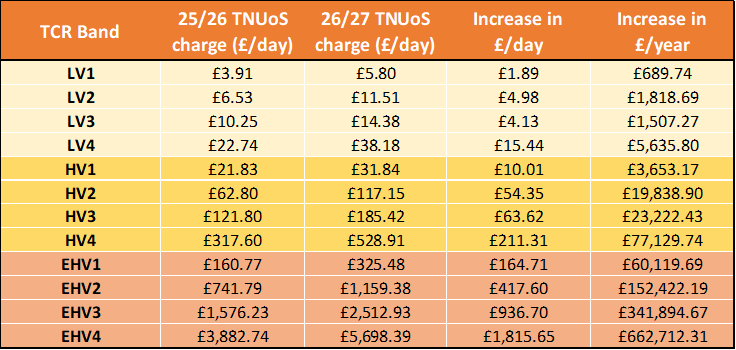
The TNUoS rate that businesses pay is set by NESO (National Energy System Operator). How much a meter is charged per day is dependant on the assigned TCR band. For sites with lower expected consumption, they will be grouped in a lower band, whereas the largest consumers will be in the higher bands and they will be charged more.

With the change in charges, the lowest level of consumer will now be paying almost £700/year more in TNUoS standing charges. While the largest consumers will be paying over £650,000/year more.
DUoS
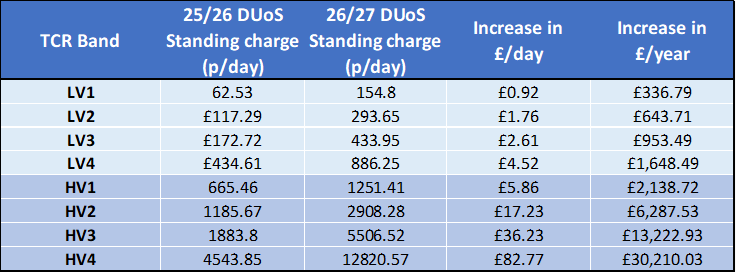
Unlike TNUoS costs, DUoS are not set nationally but by regional Distribution Network Operators. Whilst the % increases in DUoS charges are somewhat similar across the board, there are regional variations, so if you want to know the exact change in your DUoS costs, contact us, and we can calculate the exact difference.

DUoS charges for EHV meters are dependent on the MPAN and not the band. Let us know if you require assistance with checking the charges of your EHV meters.
What this means for British businesses
A mid-sized factory with a high-voltage connection could be looking at between a £26,000 - £107,000 increase regardless of changes in their consumption.
For businesses already dealing with tight margins, global supply chain pressures, and rising labour costs, these increases can have a big impact on profitability. Especially when -- for the majority of businesses (depending on the contract) -- they are applied automatically via supplier pass-through mechanisms.
What You Can Do Now
While network charges may seem uncontrollable, there are steps that businesses can take to mitigate their impact:
1. Assess your TCR banding. Many businesses are unknowingly placed in higher DUoS or TNUoS bands. A misclassification of bands could cost your business thousands every year. We can help you audit your current setup, see if changes can be made, and challenge incorrect allocations.
2. Review your kVA capacity. For many businesses, a kVA capacity review can save thousands per year and possibly move your meter into a lower TCR band
3. Explore demand flexibility and onsite generation. Where possible, shifting load to off-peak periods or investing in onsite renewable or storage solutions can reduce chargeable capacity and unit costs.
Network costs are no longer a small part of your energy bill. With DUoS and TNUoS costs rising sharply from April 1st, 2026, businesses can act now to see what can be done to mitigate these charges.
We specialise in helping businesses navigate complex energy cost structures, optimise their billing, and put in place tailored strategies that help reduce energy spend. If you would like help with any of the issues mentioned in this article, contact us today to see how our team of experts can help you ahead of these rising charges.
Contact Us