

1 July 2026

June 2026 Review

This June saw a record-breaking heatwave and the commencement of an expanded World Cup, but it wasn’t just football and tropical temperatures that were a cause for celebration. This month also saw the re-opening of the Strait of Hormuz as the US and Iran brokered a tentative peace-deal that sent waves of relief across volatile global energy markets. 

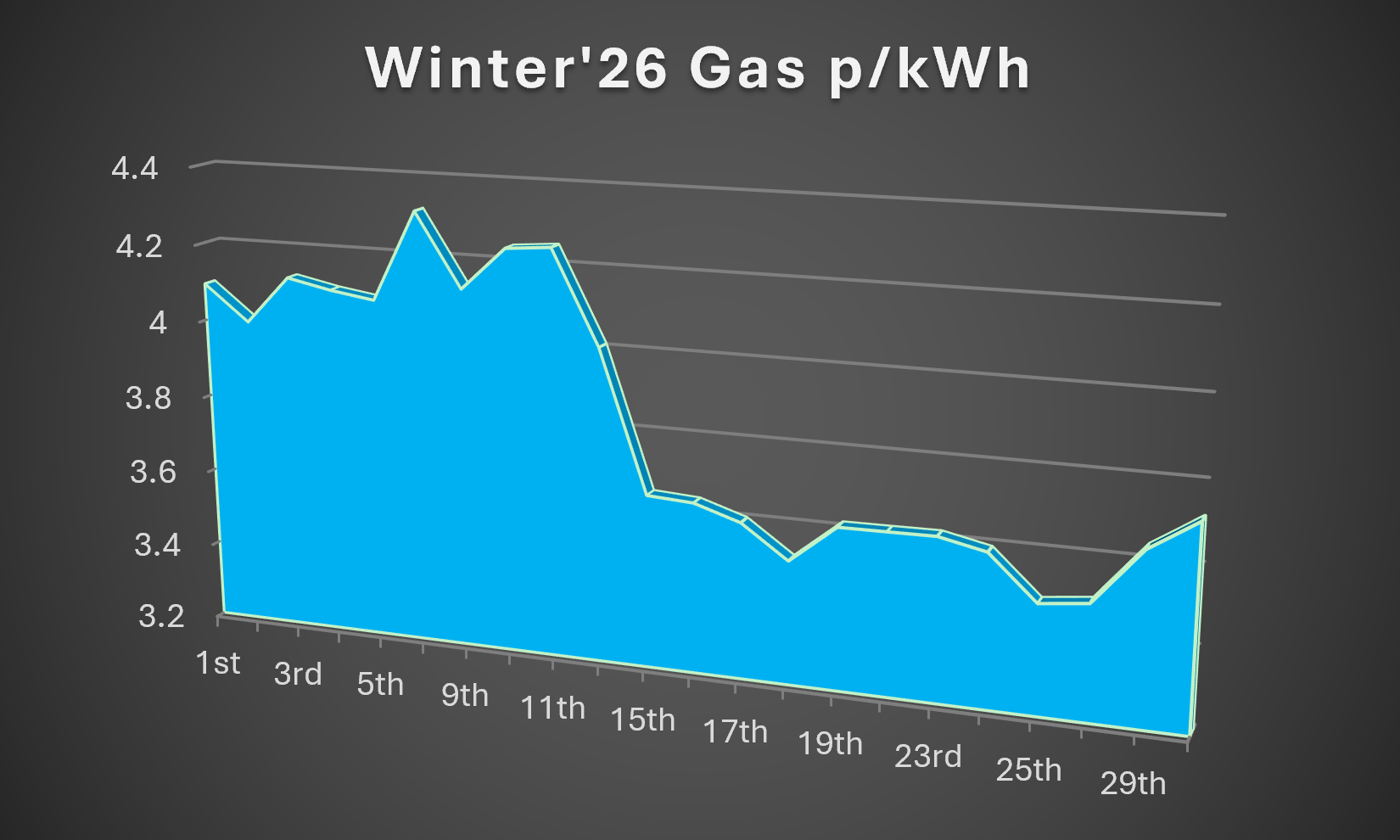
While prices steadily rose at the beginning of the month, the news of the US and Iran reaching an agreement caused a notable drop in the gas and electricity markets, most notably for the upcoming winter season. For a business set to consume 1,000,000kWh of gas this winter, the difference between the high and low point of the month would equate to a saving of over £5,500.


The geopolitical tension between the US and Iran had remained as the single biggest driver of market anxiety throughout June. After continued posturing from both sides, it had appeared that the war was set to escalate before a Memorandum of Understanding (MoU) was signed on June 17th. The MoU led to an immediate re-opening of the Strait of Hormuz for cargo vessels, enabling the recommencement of LNG shipments from the region. Talks are expected to progress with a 60-day deadline given for the US and Iran to reach an agreement. Should they not be able to do so, there is a possibility that access to the Strait may once again be limited.


Though the news of LNG shipments restarting may have offered relief to nations who rely on imports, not all of the news out of the Middle East was positive. Qatar, who are the largest LNG exporter in the region, announced that it will be able to raise production capacity to 80% by August, but it may be a couple of years before full capacity is restored. The Ras Laffen LNG facility was damaged during the war, and repairs to the facility will have an impact on production capacity until 2028.

With the news of LNG shipments from the Middle East restarting, June offered positive news on the supply side of the picture, however, record temperatures as a heatwave spread across Western Europe meant news on the demand side wasn’t as positive. The late-June heatwave caused an immediate spike in wholesale electricity prices as air conditioning demand soared across Europe. With many European nations having diminished gas reserves, this increase in consumption could have an impact on energy prices that extends to the coming winter.


Outlook

The progression of talks between the US and Iran will continue to be the dominant factor behind gas and electricity price movements in July. Any breakdown in these talks will see prices return to their March highs, whereas news of a sustained peace-deal will see prices take a further step towards their pre-war levels.


European nations are now facing a race against time as they look to meet their mandated gas reserve levels ahead of November. Given the limited supply currently available – and that many EU nations are already taking steps to cut taxes on electricity to reduce the pressure on the end-user – it seems likely that the 90% reserve level may be met with some leeway this year. If no changes are made to the existing regulations, we may see European nations drive prices up in a bidding war for the available LNG. Although there are limitations to how far this would raise prices – many Asian nations switch to coal-generation when it becomes more cost-effective – it could keep prices higher than their pre-war levels even if a binding peace deal is agreed.

The UK government has often been accused of neglecting businesses in their push to achieve climate goals. They have failed to protect the nation’s energy security despite having access to the oil and gas rich North Sea. Now they are risking angering more business owners – particularly those in energy intensive industries – as they announce a new scheme aimed at limiting energy costs for data centres. Under the new scheme, data centres built in designated regions could be eligible for up to 24p/kWh discounts on their electricity bill.

This raises many questions about where the government’s priorities lie and whether there will be any further legislation to aid UK businesses -- similar to the Energy Bill Relief scheme launched in the aftermath of the Russia-Ukraine conflict causing a rapid spike in energy prices.


If you want to find out if your business is eligible for any existing government discount schemes, or if you want to see if there are any immediate cost reductions that can be made with your energy spend, SeeMore Energy are currently offering a Free Energy Health Check. Our team of experts will explore the ways that your energy bills can be reduced and provide you with a clear plan to help guide you through the current market volatility. Contact us today to see how we can help you lower your energy costs.

31 May 2026
By Adam Novakovic May saw temperatures soar as many dusted off their barbecues, while others headed to the parks and beer gardens to make the most of the unseasonably warm weather. In the energy markets, a much-anticipated peace-deal failed to materialise as the conflict between The US/Israel and Iran looks set to continue into the summer months.
27 May 2026
The Network Charging Compensation Scheme (NCC) For many UK businesses, rising electricity costs remain one of the biggest pressures on profitability and competitiveness. While wholesale prices often dominate headlines, network charges have been rising sharply and make up a larger percentage of energy spend than ever before. This is particularly true for energy-intensive industries. The Network Charging Compensation Scheme (NCC) was introduced with a goal of providing eligible businesses with compensation against specific electricity network costs. However, despite the potential savings available, many organisations are either unaware of the scheme or unsure whether they qualify. For businesses with high electricity usage, the NCC could provide substantial financial relief and improve long-term competitiveness. Why Was the NCC Introduced? The UK government introduced the Network Charging Compensation Scheme as part of a broader effort to support energy-intensive industries (EIIs) facing increasing international competition and high domestic energy costs. Many UK manufacturers compete globally against businesses operating in countries with lower energy costs and lower network-related charges. Without support mechanisms, these costs can make British industry less competitive. The NCC was designed to compensate eligible businesses for a proportion of specific electricity network charges -- helping reduce the disparity between UK energy costs and those faced by overseas competitors. The scheme complements other forms of support available to qualifying industries, including the IETF , the ESL , and the ETII Exemption Scheme . What Are the Benefits of the NCC? The primary benefit of the scheme is straightforward: lower electricity costs. Eligible businesses can receive compensation against Contracts for Difference , Renewables Obligation (RO) , Feed-in Tariffs (FIT) , and costs related to the Capacity Market . For a business consuming 4,000,000kWH of electricity per year, this can lead to annual savings of £225,000 . The NCC can allow businesses to: