

Review kVA charges
Reviewing kVA Charges
When UK businesses look to reduce energy spend, they often focus on unit rates, contracts, or efficiency measures. However, one of the most overlooked areas is kVA capacity. Whether your agreed capacity is set too high or too low, it can quietly add unnecessary costs to your energy bills. A simple review can save £1,000s with minimal disruption.
What is kVA capacity?
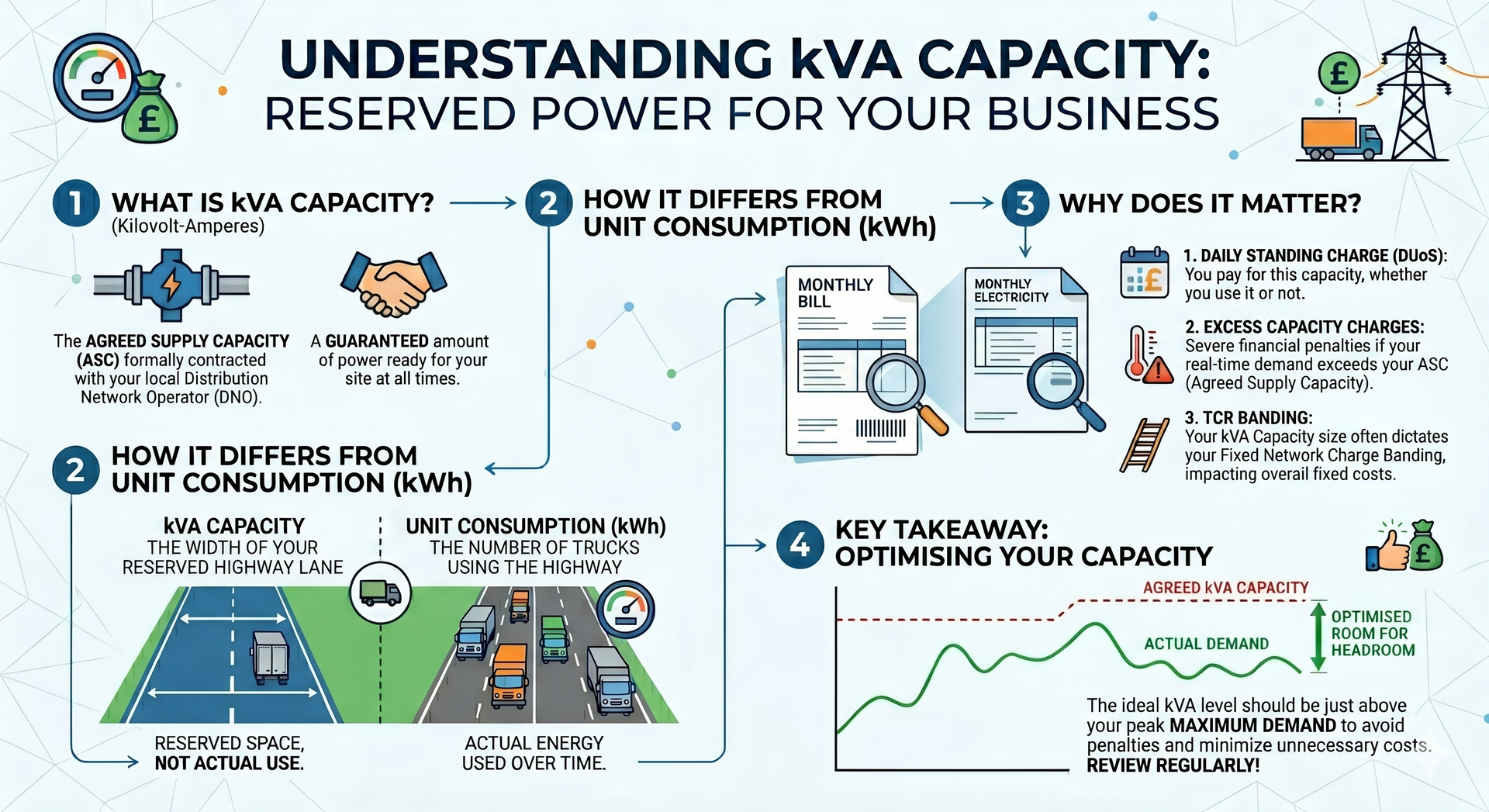
kVA (kilovolt-amperes) represents the maximum electrical load your site is allowed to draw from the grid at any one time. It’s essentially the “size” of your connection. Your agreed capacity is set with your Distribution Network Operator (DNO) and determines how much power your site can safely access.
When your capacity is set too low, you risk exceeding it; when set too high, and you may be paying for capacity you don’t actually use.
How do kVA capacity charges work?
Businesses are charged for their agreed capacity, regardless of whether they fully utilise it. If your capacity is set higher than your actual usage, you’re effectively paying for unused headroom.
On the other hand, if your capacity is too low and your site exceeds it, you may incur excess capacity charges or risk operational issues.
Striking the right balance is key, and that’s why reviewing your kVA usage should be a regular occurrence.

KVA capacity reviews
The good news is that your kVA usage can be assessed relatively easily. By analysing your site’s historical demand -- typically over the past 12 months -- you can identify your peak usage and compare it to your agreed capacity.
This data can be requested from your DNO or accessed via half-hourly metering systems. With accurate insights, businesses can make informed decisions about whether to increase or reduce their capacity to better align with actual needs.
Additional savings
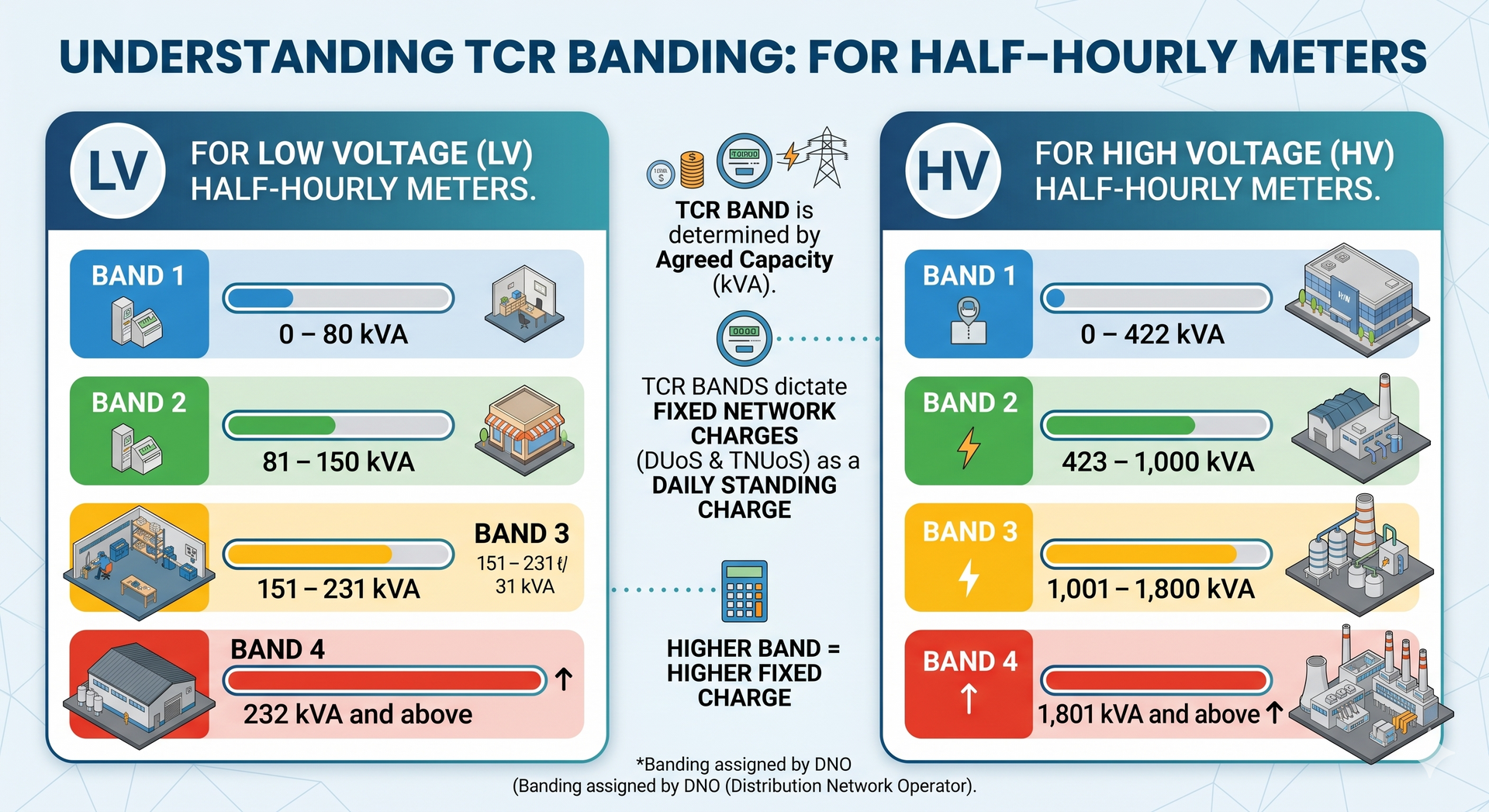
Reviewing your capacity doesn’t just impact your direct capacity charges. It can also influence your Targeted Charing Review (TCR) Banding. TCR bands are used to calculate certain fixed network costs, including elements DUoS (Distribution Use of System) charges.
By reducing your agreed capacity where appropriate, you may fall into a lower band and unlock further savings across your network charges. This is where the real value often lies, as these charges make up an increasing portion of your overall energy costs.

We recently worked with a business that had an agreed capacity of 500 kVA, despite never exceeding 320 kVA over the previous year. After reviewing their data and consulting with them about whether usage is expected to remain stable for the foreseeable future, we were able to reduce their capacity to 350 kVA. This still provided a comfortable buffer but lowered their capacity charges by almost £400/month.
In addition, we were able to request that the DNO reviewed their TCR band, which led to the meter being lowered from HV2 to HV1. This resulted in a further £3,200 in savings on network charges.
In total, the business achieved recurring savings of over £7,500 per year, without any operational changes.
Take control of your capacity costs
kVA capacity reviews are a simple but highly effective way to reduce energy costs. Yet many businesses are unaware of this process that could significantly reduce their energy costs.
At SeeMore Energy, we help UK businesses analyse their usage, benchmark their capacity, and identify opportunities for savings. Through our expertise and trusted partners, we ensure your energy setup is aligned with your actual needs.
If you haven’t reviewed your kVA capacity recently, there’s a strong chance you could be overpaying.
Get in touch with us today to uncover potential savings and see how much we can help you save.