16 April 2026

Expanded BICS: 10,000 UK Manufacturers eligible for 25% discount on electricity bills

The Updated British Industrial Competitiveness Scheme

On April 16th, the UK government announced an expansion of the British Industrial Competitive Scheme, increasing the support offered to Energy-Intensive Industries. The original British Industrial Competitiveness Scheme (BICS) was launched in April 2024 to help manufacturers operating in foundational industries remain competitive by reducing electricity costs. This gave businesses an exemption for many of the environmental levies that have been largely responsible for the electricity bills of many UK businesses being uncompetitive when compared with their continental counterparts.


Who is covered?

Currently the BICS covers over 7,000 eligible businesses, with the announced expansion, over 10,000 UK businesses will be covered.


One of the goals of the initial scheme was to offer relief to foundational manufacturers, including:

  • Component manufacturers
  • Intermediate goods producers
  • Industrial suppliers to sectors (e.g. automotive, aerospace, pharmaceuticals)


We are now seeing more sectors being made eligible through an expanded set of SIC and product classifications, meaning many businesses that previously fell outside the scheme may now qualify.


However, eligibility is still targeted. Businesses must be engaged in manufacturing activity, operate within the eligible sectors, and meet a defined electricity intensity threshold.


How is the discount applied?

BICS primarily reduces costs through exemptions applied directly to your electricity bill. However, following the latest expansion, eligible businesses will also receive a one-off backdated payment in April 2027. This covers the support they would have received from April 2026 and is essentially a refund on the charges they are exempt for.

Eligible businesses will receive exemptions from:


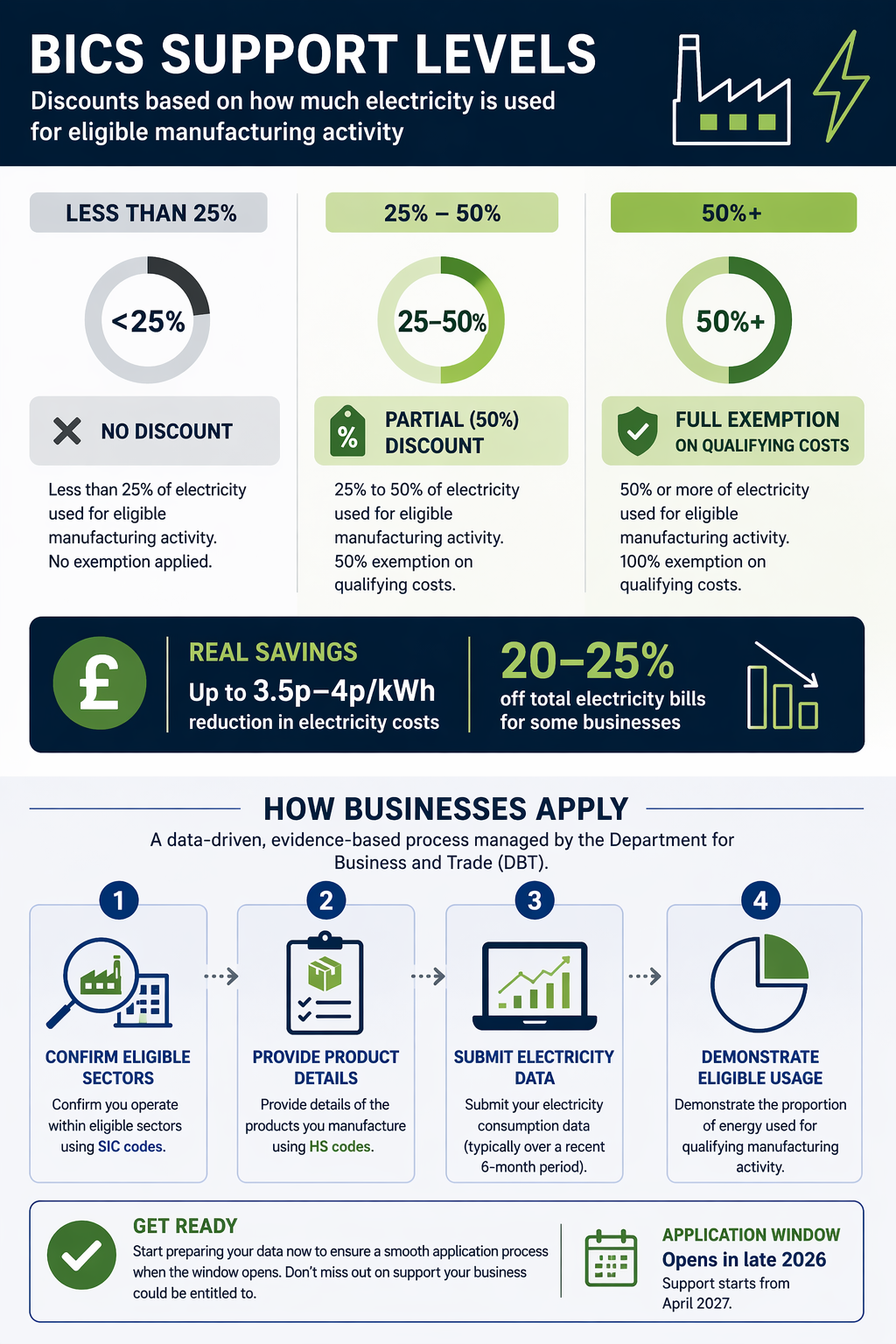
These exemptions are applied by your energy supplier, reducing the price your business pays for electricity, with the level of support depending on how much of your electricity usage is directly tied to eligible manufacturing activity:


  • Less than 25% = No discount
  • 25%–50% = Partial (50%) discount
  • 50%+ = Full exemption on qualifying costs


In real terms, this could equate to savings of up to 3.5p-4p/kWh, or as much as 20–25% off total electricity bills for some businesses.


How do businesses apply?

The application process will be managed by the Department for Business and Trade (DBT) and is expected to be data-driven and evidence-based.

Businesses will need to:


  • Confirm they operate within eligible sectors (via SIC codes)
  • Provide details of the products they manufacture (via HS codes)
  • Submit electricity consumption data
  • Demonstrate the proportion of energy used for qualifying manufacturing activity


Applications will be open in the following windows:

  • 1 October 2026 – 30 November 2026: Businesses are invited to provide information to DBT to support identification of eligibility.
  • 1 October 2026 – 8 January 2027: DBT will assess grant eligibility for businesses.
  • November 2026 – 1 April 2027: Once eligible businesses begin being confirmed, electricity suppliers will have until April to process exemptions for eligible businesses.


How we can help

For many businesses, the complexity of BICS lies in the qualification and application process. That’s where we come in.


As an energy broker working closely with UK manufacturers, we can:


  • Assess your eligibility against the latest BICS criteria
  • Translate SIC and product classifications into plain English
  • Analyse your energy usage and cost structure to estimate potential savings
  • Support with application submissions and data gathering
  • Ensure your supplier correctly applies the exemption to your bills


Perhaps most importantly, we can help you identify whether this expansion creates an opportunity where previously there wasn’t one.


With over 3,000 additional businesses now expected to qualify, this expansion represents a significant opportunity for UK manufacturers to reduce costs and improve competitiveness.


If you’re a UK manufacturer and want to understand whether you qualify -- and how much you could save -- get in touch today for a free, no-obligation advice from a team of experienced professionals.

Contact Us

by Craig Watson 27 March 2026
With consumer spending declining and OFGEM raising their price cap, you would be forgiven for seeing February as a month where negative news was at the forefront, but in the energy markets, this was not the case.
by Craig Watson 27 March 2026
In a year that began with falling energy prices, there were recurring catalysts that led to prices climbing steadily higher. Geopolitical uncertainty and the perennial threat of escalating conflicts meant fear would maintain a constant presence in the wholesale markets. We will look back at the key energy stories from 2024, and how the energy markets are likely to shape up in 2025. Quarter 1  The year began with cautious optimism as the UK’s gas reserve levels were healthy and prices for the Summer’24 season were in freefall. In February, prices pulled back to their lowest levels since 2021, and for the first time in a while, we identified that there was greater potential for upside risk than for further downward price movement: “ there now (exists) an asymmetrical element of risk should the market encounter a supply-side problem of significance. ” During February we had advised customers on flexible contracts that this was an ideal time for making purchases. March would see prices begin to ascend again as international conflict would create problems with LNG imports, and we would highlight the geopolitical risks as an area for concern moving forwards: “ fears remain and there are potential negative catalysts that could lead to prices rising further, with the main factors to watch out for being based on geopolitical unrest. “ For a business that purchases their energy in advance, this quarter was the optimal time for purchasing during 2024. In February, electricity prices for Winter’25 were down to 7.75p/Kwh, and as low as 6.05p/Kwh for Summer’25. Winter’25 ended the year with prices above 11.1p/Kwh, with Summer’25 prices exceeding 9p/Kwh. For a company that uses 500,000Kwh of electricity per month, the difference between buying at the February low point compared to today’s prices would represent a yearly saving of over £200,000.
Show More